
AI news ·
Gartner predicts AI agents will outnumber sales reps 10-to-1 by 2028
Gartner predicts AI agents will outnumber human sellers 10 to 1 by 2028. Yet fewer than 40% of salespeople will find these tools improve productivity.
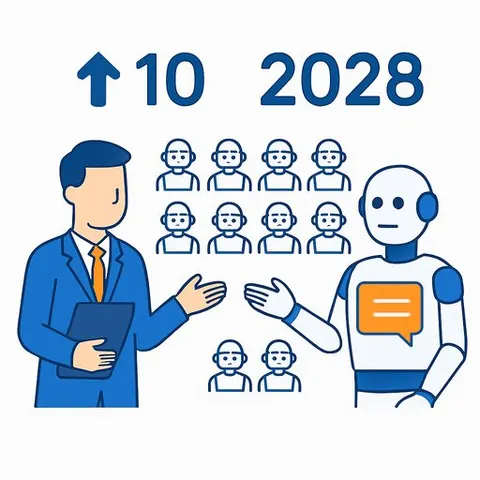
By 2028, AI agents will outnumber human sellers by a factor of 10, but fewer than 40% of salespeople will say those agents improved their productivity, according to Gartner, Inc. The forecast, released July 28, 2026, highlights the risk of "agent sprawl" - a surge of digital activity that fails to move the needle on seller impact.
The productivity paradox in sales
A Gartner survey of 210 chief sales officers (CSOs) and senior sales executives, conducted between January and February 2026, found that 60% of CSOs say their revenue number is largely driven by factors outside their control. This misalignment points to a deeper productivity paradox: rising investments in talent, tools, and processes produce stubbornly flat returns.
"Without the right data foundation, workflow integration and seller experience, CSOs risk creating agent sprawl, with more digital activity, but little improvement in seller impact," said Dan Gottlieb, VP Analyst in the Gartner Sales practice.
Gartner predicts that by 2028, CSOs who overhaul data, automation, and user experience will be five times more likely to gain ROI from AI than those who choose quick fixes.
Three steps to avoid agent sprawl
To turn AI agents into meaningful productivity gains, CSOs should focus on three actions:
- Own AI-forward sales infrastructure: Build a centralized context layer that connects enterprise data, systems, and seller judgment so AI agents can generate more relevant, enterprise-specific outputs.
- Orchestrate winning sales behaviors: Use AI to reduce administrative burden, scale top-performer expertise, and provide managers with data-driven insights that improve coaching and decision making.
- Harvest AI's impact on sales capacity: Move beyond tracking AI only through time savings and measure how it expands seller capacity, improves effectiveness, and supports commercial outcomes.
"AI agents should not be viewed as a shortcut to sales productivity," said Gottlieb. "They are only as effective as the systems they operate within. If those systems are fragmented, the agents will scale the fragmentation. If the systems are redesigned around seller judgment and customer value, agents can help create meaningful capacity."
Executing these actions requires both technology changes and upskilling. Sales organizations that invest in AI literacy and automation skills - through resources like AI Agents & Automation Training and AI for Sales Courses & Training - are better positioned to redesign their systems for lasting productivity gains.
Why this matters for sales professionals
For individual sellers, a wave of AI agents doesn't automatically lighten the load. If the underlying data and workflows remain disconnected, AI will only add noise. Salespeople should push their leaders to fix the systems first - demand clear data pipelines, workflow integration, and tools that support their judgment, not replace it. The difference between getting buried by bots and getting a real lift in capacity will come down to how well the sales system is rebuilt before the agents arrive.