
AI news ·
Gen Z workers report highest AI guilt as dependence fears grow
Nearly 75% of U.S. workers fear becoming too dependent on AI, with Gen Z reporting the highest rate at 78%, per a survey of 1,000 employees. AI saves users 15 hours weekly, yet only 31% feel more productive.
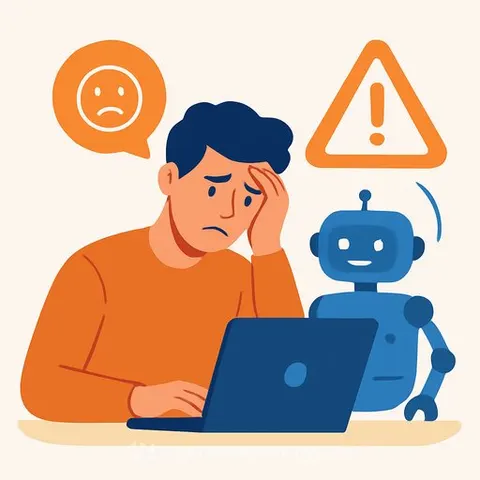
Nearly three-quarters of American workers say they worry more about becoming too dependent on AI than about falling behind on adopting it, according to a new report from the Acceleration Agency. The survey of 1,000 full-time U.S. employees, conducted in May, found the concern spans gender, generation, and job level-but Gen Z workers report the highest rate at 78%, compared with 72% among Millennials and 74% among Gen X.
"Our work suggests people are increasingly worried that relying on AI could erode the abilities they value most," said Monica Chun, president of Acceleration Community of Companies, in the report.
For HR professionals, the findings point to a shift in how employees view AI: less as a tool to master and more as a crutch that may be costing them the skills that made them valuable in the first place.
The productivity paradox
Workers who use AI on the job say it saves them an average of 15 hours per week. Yet only 31% agree that AI makes them significantly more productive.
Mike Moschella, head of Acceleration Agency's intelligence division, said in the report that the added information from AI creates a new burden of deciding what to trust-which explains why time savings are not translating into a feeling of productivity.
Skills, guilt, and hidden AI use
Two-thirds of workers worry AI is eroding their writing skills, and the same share worry it is diminishing their creativity, according to the report. Gen Z respondents report the highest rates of AI-related guilt of any generation surveyed.
"AI has given me a lot of confidence. Maybe too much confidence," said Elijah, a 32-year-old respondent from California, in the report. "I worry it's making me worse at the things that made me good at my job in the first place."
Thirty percent of respondents said using AI has felt like cheating, while 17% have kept their AI tools or workflows secret from colleagues or supervisors. Only 28% of workers who use AI at work rely on a company-wide or team-shared platform, meaning most employees are assembling their own AI toolkits without employer oversight.
"I'm not sure what's real anymore, what's AI, and the rules keep changing," said Alex, a 22-year-old respondent from California, in the report.
For HR teams, the rise of unsanctioned "shadow AI" raises practical questions about training, oversight, and liability. As AI for Human Resources resources continue to develop, the gap between sanctioned and unsanctioned use is likely to become a central workplace issue.
Four concrete risks for employers
The Acceleration Agency's findings align with a growing body of research from universities, business consultancies, and cybersecurity firms pointing to four distinct risks when employees become overly dependent on AI:
- Erosion of critical thinking. Employees who trust generative AI more report engaging in less critical thinking when completing work tasks, according to a CHI 2025 study by Lee et al. A related MIT Media Lab brain-scan study found lower cognitive engagement among AI users than among those working unassisted.
- Institutional skill loss. Judgment, problem framing, and creative thinking are the organizational skills most at risk from AI-driven deskilling, according to BCG's Institute for People, Strategy and Change as cited by Netwrix. Employees may keep their titles while losing the underlying expertise those roles are meant to represent.
- "Cognitive surrender" and unchecked output quality. Confidence in AI is one of the strongest predictors of whether knowledge workers apply critical thinking to its output at all, according to Microsoft Research via Forbes. A Wharton School paper by Shaw and Nave labeled this pattern "cognitive surrender," warning it can cancel out the productivity gains AI was meant to deliver.
- Shadow AI security and legal exposure. More than one-third of employees admit to sharing sensitive work information with AI tools without employer permission, according to IBM. Unsanctioned use has also been tied to intellectual-property leaks and potential discrimination liability when AI outputs inform employment decisions, per The Register citing Verizon data and Netwrix.
"For the past two years, organizations have measured AI success primarily based on adoption rates and productivity gains while overlooking the negative consequences of worker dependence on AI," the Acceleration Agency said in the report. "In contrast, ACC's findings cite significant concerns around how executive dependence on AI can lead to declines in human judgment, creativity, and confidence."
Why this matters for HR professionals
HR teams are already being asked to track AI adoption metrics and deliver productivity numbers. The Acceleration Agency's report suggests those metrics miss the real story: employees are losing confidence in their own abilities, hiding their AI tools, and skipping company-approved platforms altogether.
The practical takeaway: HR should measure AI's impact on skill retention, not just adoption rates. For teams building AI governance policies, the AI Learning Path for HR Managers covers how to manage AI-related workforce concerns including the shift from measuring AI adoption to measuring AI's actual effect on employee capability. The report's own conclusion is direct: business leaders need to ensure AI helps employees become more capable overall, not just more efficient.