
AI news ·
Generative AI ads flood Singapore market, but poorly made ones could backfire on brands
Generative AI ad demand in Singapore has surged 4-5x since late 2025, but sloppy execution is pushing consumers away. Experts warn poorly done AI work signals carelessness and can damage brands, even as enterprise clients rush to appear tech-forward.
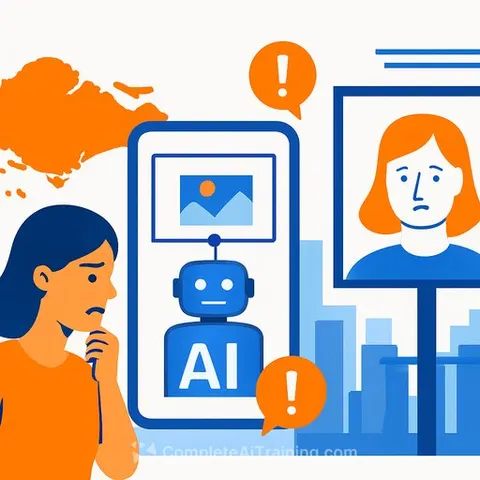
Generative AI ads are flooding Singapore's market as clients rush to appear tech-forward - but poorly executed work is turning consumers off, and industry experts warn the backlash is real.
Marketing industry experts told CNA that demand for AI-focused creative services has risen sharply over the past six months. Clients range from small businesses to government agencies. This year's National Day celebrations used generative AI for songs, films and marketing materials. Local brand Mr Bean launched its own virtual idol. Household names like Dyson and Walch run AI livestreams on Lazada and Shopee.
Enterprise clients lead demand
AI Studio, a Singapore agency specialising in AI-generated content, said enquiries have grown four to five times compared with late 2025 to April 2026. Founder Carol Tan, 36, expected small companies to drive interest. "I was very wrong because actually most of our clients are enterprise clients. Enterprise clients are the ones who want to be at the forefront of AI," she said.
Tan, who previously ran a traditional marketing agency, said businesses once hid their use of AI. "Now actually it's the other way round. People want to be known as cutting edge."
But a scroll through Reddit shows the flip side: commenters mocking ads that look too obviously AI-generated. The Advertising Standards Authority of Singapore (ASAS) received two pieces of feedback on AI use in ads in the first half of 2026, roughly the same as in 2025. Chairman Bryan Tan warned that disclosure alone doesn't solve the problem. "Disclosure of the use of AI alone does not whitewash this issue," he said.
Losing credibility
Mediocre ads irritate consumers whether or not AI was used, said Sabine Benoit, professor of marketing at Singapore Management University. "But using AI can signal that the company has not put much effort into the product, and that can come across as negligible. This is, of course, the opposite of the signals the organisations want to send."
Consumers are unlikely to judge a company negatively just for using AI, she added. Problems arise when execution feels careless, generic or misleading. "Ultimately, using AI will not necessarily damage a brand. Using it poorly can."
Virtual influencers can make things worse. Associate Professor Ang Swee Hoon from the National University of Singapore's marketing department said AI avatars "give them the creeps", causing mistrust rather than curiosity. The audience may also feel that brands spending money on advertising should show the "truth" or "reality" - and that builds credibility, she added.
Not all publicity is good publicity, experts stressed. Negative buzz can escalate wildly online, and ads may have to be pulled entirely, meaning the campaign failed its original objectives.
Nanyang Technological University's Assistant Professor Looi Jie Min, who researches digital advertising, said people see creativity as a core human trait rooted in personal experience, emotion and cultural understanding. "When they encounter AI trying to be in these creative fields, they might have a kind of negative reaction because they believe that AI should not be a replacement for human creativity."
Speed, scale and cost
Despite the risks, demand keeps growing. Brands and agencies cite three main benefits: speed, scale and showing relevance to current trends. AI Studio's Tan said the team can turn a project around in 24 to 48 hours. "If let's say they did give it to a traditional agency, it will cost them a lot more to be able to shoot in multiple countries, multiple languages. But with AI, the scale is limitless."
Costs vary widely. A simple one-minute video for an SME runs about S$1,000. A multinational wanting complex, frame-by-frame editing could pay S$20,000.
IdoLive founder Kevin Zhang, 56, runs AI avatar livestreams for brands like Walch and Acer on Shopee and TikTok Shop. Enquiries have grown 20 to 30 per cent each month since the start of 2026. A human host costs S$3,000 to S$4,000 a month and works four to five hours a day. An avatar costs S$458 a month and streams 24 hours nonstop. Both typically attract about 10 viewers at a time, Zhang said.
The strategy only works for established brands, he added. Consumers need to already know what they're looking for - then it doesn't matter whether the host is human or AI.
Agoda used generative AI for a recent local campaign. Country director Pranjal Kalra said the technology increased video adaptations from 64 to 720 per month. "Without the help of generative AI, executing this across multiple scenarios and formats would have been costly and time-consuming."
Circles.Life has used AI in copywriting, image creation and video production since 2025. Director of brand and marketing Priyadharshini Seevaratnam said tasks that spanned hours now take a fraction of the time, and the company cut stock image and footage licensing costs. But AI is not an end-to-end solution - every asset goes through the same quality checks as other campaign materials, and AI doesn't make final creative decisions.
PUB uses AI where appropriate, including visuals for its flood resilience campaign in November 2025, which combined real actors, photography, stock images and AI-generated water and background props. PropNex used generative AI for animated visuals in its National Day Parade commercial, calling the decision "primarily a creative one" rather than a cost-cutting exercise.
Who should avoid generative AI
Charlie Tan, 28, founder of AI agency Touchmkt, sometimes advises clients in high-trust industries to skip AI altogether. A tuition centre making testimonial videos should use real parents, children and teachers on camera, he said - "to show that it is 'legit'".
Larger brands face the most backlash, said NTU's Asst Prof Looi. Research shows the reaction is especially strong for luxury brands. "If you want to get a consumer to spend big bucks to buy from a luxury brand, and yet your storytelling lacks the effort, why should I be buying from a brand that doesn't even want to put in the work to get my money?"
Dr Jun Yu, assistant professor at NUS' communications and new media department, noted that small businesses may be forgiven for using AI due to budget limits, but audiences see large corporations as choosing AI. People start wondering what else has been quietly automated - customer service, quality checks, complaint handling, he said. "It is not just about a single (instance of) AI use for ad-making, but whether the willingness to spend effort and resources are still there."
There's also a moral dimension. Many people now know generative AI was trained on human artists' work without consent, and that the same technology threatens those livelihoods. "So a synthetic ad becomes more than just a marketing choice, rather a visible symbol of broader concerns about fairness, inequality and the social costs of AI," said Dr Yu.
Why this matters for creatives
The takeaway for creative professionals isn't whether to use AI - it's how to use it without signalling carelessness. The brands getting it right treat AI as one tool in a workflow that still includes human judgment, quality control and brand consistency checks. Those treating it as a shortcut are the ones getting mocked online and losing consumer trust.
For creatives, the opportunity is in mastering the judgment side: knowing when AI strengthens a campaign and when it undermines it. Courses like AI for Creatives and Generative Video training can help build that skill set - but the core competency is editorial taste, not just technical prompt skills.