
AI news ·
Ghana's AI education pilot shows 77 percent teacher adoption, but learning outcomes remain the test
Ghana rolled out AI tutoring apps to all 712 senior high schools in October 2025, with 77 percent of 68,000 teachers adopting them. That compares to Khan Academy's admission that its AI tutor failed to gain traction despite major backing.
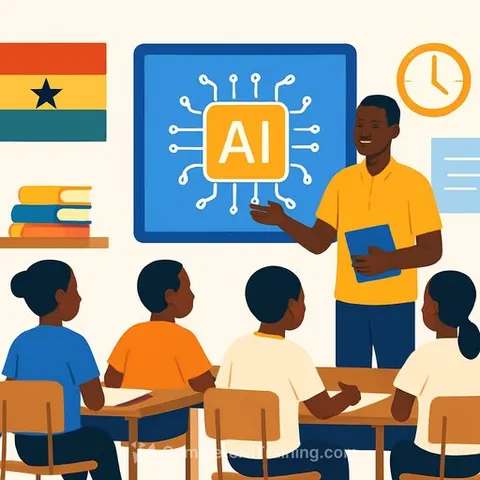
Ghana's Ministry of Education rolled out AI tutoring apps to all 712 senior high schools in October 2025, and early results suggest the country may have found a model that actually works. A third-party study shows 77 percent adoption among 68,000 teachers, with more than half using the tools multiple times per week - a striking contrast to faltering AI education projects in wealthier nations.
The stakes are high. Ghana's education system faces a learning crisis that access metrics hide. While nine in ten basic school-age children are enrolled, only 54 percent of Primary 4 pupils are proficient in English and 46 percent in mathematics, against a national target of 90 percent by age 10. The World Bank's Human Capital Index puts expected schooling at 11.6 years by age 18, but learning-adjusted years drop to 5.7. Nearly six years of schooling produce no measurable learning.
The failure of tool-first AI
This month, Sal Khan, founder of Khan Academy, publicly admitted that Khanmigo - his flagship AI tutor serving over 100 million learners - hasn't gained adoption in practice. Khanmigo had every advantage: first access to GPT models, Microsoft backing, Gates Foundation grants, and state subsidies. The failure wasn't resources, but method. The team built the tool, then pushed it onto teachers and students. When students didn't use it, the chatbot was made more intrusive. When that didn't work, teachers were blamed, then students.
Ghana took the opposite approach. The AI apps, built with PlayLab, are embedded inside coaching, lesson preparation, and curriculum delivery practices teachers already use through national Professional Learning Communities that meet weekly in every school. The apps run on Ghana's own curriculum materials - teacher manuals, learner resources, and national values frameworks - rather than generic content.
A partnership model with local control
The governance structure matters as much as the technology. T-TEL, a Ghanaian education non-profit, leads implementation. PlayLab provides the AI tool with subsidised compute from Amazon Web Services and Anthropic. The Mastercard Foundation funds the pilot. The Ministry of Education acts as anchor client, defining what Ghana needs.
The approach aligns with the African Union's Continental AI Strategy, endorsed in Accra in July 2024, which calls for respecting context, data sovereignty, infrastructure limitations, and local capacity building. Ghana is one of the first AU member states implementing AI in education consistent with that framework. For educators exploring how AI fits into teaching practice, resources like AI for Teachers offer practical grounding, and broader coverage of AI for Education tracks similar implementation questions.
What should be measured next
Ghana has completed the first hard phase: a contextually grounded, government-anchored deployment. Three priorities deserve attention. First, impact measurement. The dominant metric across AI edtech is engagement - how many users, how many chats. That's the same quantity-over-quality trade-off Ghana's education system is trying to escape. The measure that matters is whether literacy and learning-adjusted years improve, and at what cost. Independent outcome measurement should be a condition for funding scaled pilots.
Second, procurement leverage. African governments currently negotiate with large AI vendors individually, with limited technical capacity and no shared standards. A continental procurement framework - covering impact assessments, vendor transparency on training data, data localisation, and open API requirements - would shift the power dynamic. NEPAD and the African Union are developing one, and Ghana is well positioned to shape it.
Third, digital and AI fluency. As Ghana strengthens early digital fluency for teachers, it needs a roadmap for student fluency. Nations that manage this transition will build globally competitive workforces for remote work and a growing tax base.
Why this matters for education professionals
The risk with early pilot successes is mistaking the announcement for the outcome. Partnerships get press. Pilots get photographs. The conversation should shift from how many teachers have AI access to whether students' learning outcomes are meaningfully improving. For educators, the lesson is specific: AI adoption succeeds when the tool adapts to existing teaching workflows - not when teachers are forced to adapt to the tool. Ghana's 77 percent adoption rate, measured months into a national rollout, is evidence that context-first design outperforms feature-rich tools that ignore how classrooms actually operate.