
AI news ·
Global AI energy demand projected to double by 2030, reshaping power systems
AI data-center electricity demand will hit about 1,000 terawatt-hours annually by 2030, more than double today's 415 TWh, reshaping energy priorities toward reliability. Sembcorp, supplying nearly a third of Singapore's data-center power, is expanding capacity, including a 600 MW deal with Micron.
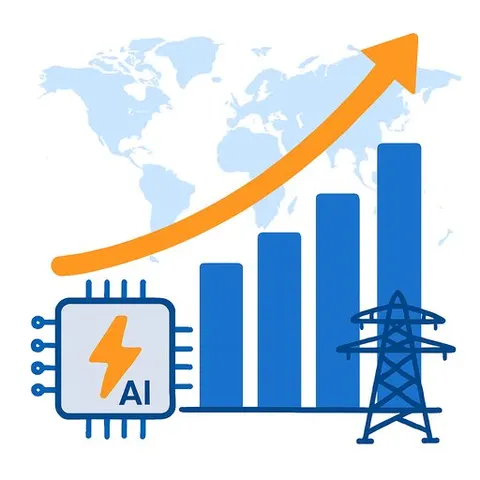
The global race to lead in artificial intelligence is becoming a race to secure energy. As countries compete to attract data centre investment, access to reliable power is emerging as the critical differentiator.
The scale of demand is unprecedented. The International Energy Agency projects that global electricity consumption from AI facilities will reach about 1,000 terawatt-hours (TWh) annually by 2030, more than doubling from around 415 TWh today. Meeting that demand will require significant investment in power generation, storage and grid infrastructure.
This is reshaping the energy transition. While decarbonisation remains a long-term priority, the rapid growth of AI and digital infrastructure is placing greater emphasis on reliability, resilience and scalability. Beyond driving demand for dependable electricity, AI is also helping companies optimise operations and manage increasingly complex power systems.
When energy meets intelligence
As power systems become more complex, operators need better tools to manage fluctuations in supply and demand. Renewable sources such as solar and wind are inherently variable, with output changing according to weather conditions, time of day and seasonal patterns.
AI helps address this complexity by turning vast amounts of operational data into actionable insights. By identifying patterns, predicting equipment behaviour and enabling faster decisions, it allows operators to move from reactive responses to predictive operations.
Sembcorp's portfolio of thermal power, renewables, energy storage and urban solutions provides a platform for deploying AI at scale. AI-enabled video analytics at its gas plants, wind farms and solar sites help identify potential safety risks and reinforce safe work practices. The company is also deploying Hyperspace, an AI-powered platform co-created by its digital and engineering teams, to support predictive maintenance. The platform analyses equipment performance and identifies potential issues before they escalate, helping engineers respond more quickly and improve asset reliability.
Sembcorp's role in the AI economy
Sembcorp supplies close to one-third of the electricity demand from Singapore's data centre and semiconductor sectors. Through long-term power purchase agreements, it serves major customers including Equinix, ST Telemedia Global Data Centres and Singtel.
In addition to gas-fired power, Sembcorp provides renewable energy solutions to support customers' decarbonisation goals. The company recently expanded its partnership with Micron through an additional 150 megawatt (MW) power purchase agreement, bringing total contracted supply capacity to 600 MW.
Beyond Singapore, Sembcorp is developing infrastructure to support AI-ready growth in key markets. This includes Wilton International Data Centre in the UK, Vietnam's first AI-ready data-centre campus at Saigon Hi-Tech Park, and Tembesi Innovation District in Batam, Indonesia. In Australia, Alinta Energy's generation, retail and development capabilities position the company to serve growing AI-driven power demand.
For operations teams, the connection between AI and energy is becoming a practical concern. The same tools that help predict equipment failures and optimise maintenance schedules depend on infrastructure that can handle the load. AI for Operations training can help teams understand how to apply these capabilities in their own environments.
Building the future energy system
AI is often described as the engine of the fourth Industrial Revolution. Every engine needs power. As adoption accelerates, the world will need more electricity, stronger grids, greater energy storage and a balanced energy mix capable of delivering stable and sustainable power at scale.
For operations professionals, the takeaway is direct: AI is no longer just a software decision. It's an infrastructure decision that affects power supply, equipment reliability and maintenance planning. Understanding how to integrate AI into operational workflows while accounting for energy constraints is becoming a core competency. An AI Learning Path for Operations Managers can provide a structured approach to building those skills.
Why this matters for operations professionals
Operations teams are on both sides of this equation. They are adopting AI to improve predictive maintenance, safety monitoring and decision-making - and they are working in facilities where energy demand is growing faster than grid capacity in many regions. The companies that manage both sides well - deploying AI to optimise operations while securing the power those systems need - will have a clear advantage. For operations professionals, that means building familiarity with AI tools and understanding the energy constraints that shape what those tools can deliver.