
AI news ·
Google adds mandatory AI disclosure labels to all ads, tightening compliance for enterprise marketers
Google now requires a visible AI disclosure label on all AI-generated or AI-edited ads across Search, YouTube, and Discover, expanding a rule that previously applied only to political ads.
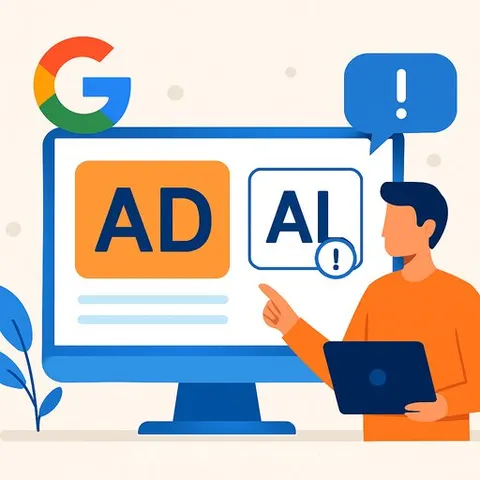
Google began rolling out a mandatory AI disclosure feature for ads across its platforms on July 9, 2026, requiring that any ad created or edited with artificial intelligence carry a visible label in the user-facing My Ad Center panel. The move extends an obligation that previously applied only to political ads to all advertisers running campaigns on Google Search, YouTube, and Google Discover.
The timing matters. Google simultaneously announced new agentic capabilities across Google Ads and Google Analytics, deepening its own AI tooling for campaign creation just as it imposes fresh transparency rules on the output. For marketing operations leaders, the two developments together mean AI-generated ad creative is now both easier to produce inside Google's ecosystem and more publicly traceable.
What the new label requires from advertisers
The disclosure surfaces under a new "how this ad was made" tab inside My Ad Center, which any user globally can open by clicking the three-dot menu or info icon on an ad. When an advertiser uses Google's own generative AI advertising tools, the label is applied automatically with no additional action required. The compliance gap opens for ads built outside Google's platform: those require the advertiser to manually activate a new disclosure control before the ad goes live.
In certain regions, the AI label may also appear directly on the ad creative itself, either automatically or when an advertiser self-reports. That visibility raises the stakes for teams that outsource creative production to agencies or third-party AI platforms and may not have visibility into exactly how each asset was generated. The compliance gap is widest for enterprise teams that produce AI-assisted creative outside Google's own tools and have no current workflow to flag it at the asset level.
The policy builds on moves Google made in 2024, when it began requiring disclosure of synthetic or digitally altered content specifically in political ads. The expansion to all commercial advertising is a significant scope increase. Meta operates a comparable system, with an "AI info" label accessible through the "About this ad" panel on its platforms, meaning advertisers running multi-platform campaigns now face analogous requirements from both major display networks.
Publisher tensions complicate the Google content ecosystem
While Google tightens its ad transparency rules, a separate but related pressure point is building on the content supply side. Reddit is actively discussing whether to shut off Google's access to its data for AI training purposes, a significant reversal given that Reddit signed a $60 million-a-year licensing deal with Google in 2024 that permitted the tech company to use Reddit content to train AI models.
Reddit is not alone. USA Today, Politico, the Economist, People, and Reuters are all evaluating how or whether to continue their working arrangements with Google. The core grievance is consistent across publishers: AI-generated answers in Google Search reduce the number of users who click through to external websites, eroding the referral traffic that has historically been the primary commercial rationale for making content indexable by Google.
Reddit executives are weighing what benefit remains in feeding content to a platform whose AI features increasingly answer queries without directing users anywhere, according to the Wall Street Journal. The companies are currently in talks about potentially renewing the deal, which is nearing its expiration. A $60 million-a-year content deal looks different when the traffic it was meant to complement has been replaced by an AI answer that never leaves Google's interface.
Operational implications for marketing and media procurement teams
For enterprise advertisers, the immediate operational question is workflow auditing. Any team using third-party AI tools such as image generators, copy platforms, or video synthesis tools to produce assets that will run as Google Ads must now build a disclosure step into the production and trafficking process. Assets that flow through Google's own tools, including the expanded agentic capabilities announced on the Google Ads and Commerce blog, carry no additional manual burden. But mixed workflows, where creative is generated externally and uploaded to Google Ads Manager, require a new control layer.
The publisher pullback creates a parallel consideration for media buyers and content-partnership teams. If major editorial platforms restrict Google's crawling rights or renegotiate content-access terms, the composition and quality of Google's AI-generated search answers could shift, and so could the audience signals that inform Google Ads targeting. Teams that depend on contextual relevance signals derived from specific publisher ecosystems should monitor how these licensing negotiations resolve.
Google's AI transparency push also aligns with a broader industry direction. The company expanded access to SynthID and C2PA content credential standards earlier in 2026, tools designed to surface deepfake content. The ad labeling system is a consumer-facing layer on top of that infrastructure. Enterprise compliance teams with obligations around content authenticity or brand safety standards should treat the new label policy as a floor, not a ceiling, particularly as regulatory attention to AI-generated commercial content increases across markets.
Why this matters for marketing professionals
For marketing teams, the practical takeaway is straightforward: audit every AI-assisted asset in your production pipeline now, before the label requirement catches you mid-campaign. If you generate creative outside Google's ecosystem, you own the disclosure burden - and the manual control is easy to miss in a high-volume trafficking workflow. Marketing managers who need to build these disclosure checks into their production processes will find practical guidance in AI for Marketing Managers, which covers adapting to new ad platform requirements. For a broader view of how AI tools are reshaping campaign workflows, AI for Marketing tracks these developments as they unfold.
The publisher negotiations are harder to plan for, but they warrant attention. If Reddit and other major content sources restrict Google's access, the AI-generated answers that sit above your ads may shift in quality and composition. Teams that rely on contextual targeting signals derived from specific publisher ecosystems should watch these licensing talks closely - and build flexibility into their media plans in case referral traffic patterns change.