
AI news ·
Has the Turing Test Lost Its Relevance in the Age of Advanced AI?
The Turing test assesses if a machine can imitate human intelligence convincingly. While iconic, it measures mimicry, not true AI reasoning or consciousness.
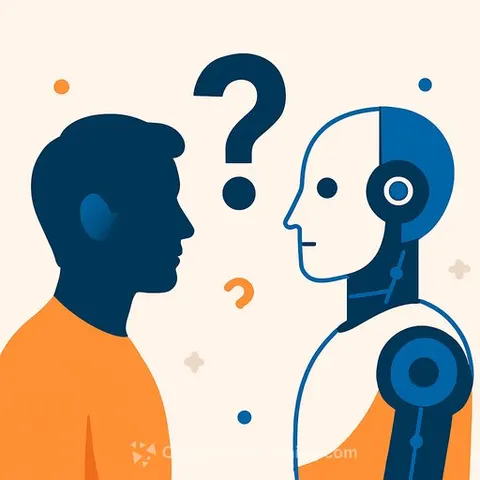
Artificial Intelligence and the Turing Test
What is the Turing Test?
The Turing test, introduced by Alan Turing in 1950, was designed to challenge the belief that computers, by their mechanical nature, cannot think. His central question was simple yet profound: "Can machines think?" To explore this, he proposed the imitation game, now known as the Turing test, to assess if a machine could exhibit human-like intelligence.
The test addresses a fundamental challenge: how to distinguish genuine thought from its imitation. Since a machine might be programmed to appear intelligent, proving true thought demands a clear definition of thinking itself. Turing suggested that if a computer's responses are indistinguishable from those of a human, it should be considered as thinking.
How Does the Turing Test Work?
Turing initially described a three-party game involving a man, a woman, and an interrogator. The interrogator’s task was to determine the genders of the two individuals based solely on their written responses, while the man and woman attempted to convince the interrogator otherwise. He then adapted this setup to involve a human and a computer, both hidden from view, communicating with an interrogator via typed messages for five minutes.
The computer passes the test if the interrogator cannot reliably tell it from the human. A later version had the computer try to convince a jury that it was human. While originally a thought experiment, the Turing test grew into a benchmark for artificial intelligence.
Turing predicted that by the early 2000s, computers would fool interrogators at least 30% of the time after five minutes. Although this did not happen as predicted, recent AI systems like GPT-4 have reignited interest. In 2024, GPT-4 was reportedly identified as human 54% of the time in a Turing test setting, surpassing Turing’s prediction. However, the test conditions differed from Turing’s original three-player game, so GPT-4 did not officially pass the test as originally defined.
Challenges and Limitations of the Turing Test
Despite its iconic status, the Turing test has notable limitations. Turing himself addressed nine objections, ranging from theological views on thought to the idea that machines lack emotions or humor. One of the most significant objections, originally raised by Ada Lovelace concerning early computing machines, states that machines cannot originate anything but merely follow instructions.
Turing countered this by questioning whether humans truly originate anything new, considering our actions are bound by natural laws and biology. He argued that computers might surprise us within their constraints, much like humans do within theirs.
Importantly, the Turing test measures imitation, not consciousness or true intelligence. It relies heavily on the interrogator’s judgment and compares behaviors only. This leads to the "Turing trap," where AI systems focus on mimicking humans instead of providing capabilities that extend human cognition.
Is the Turing Test Still Relevant?
Today, many experts view the Turing test as increasingly outdated for evaluating AI. Large language models and advanced AI systems are evolving beyond mere mimicry. They now autonomously pursue goals and perform complex reasoning, content creation, and scientific support.
The key challenge is no longer whether AI can fool humans in conversation. Instead, it’s whether AI can develop genuine common sense, reasoning, and align with human values and intentions. Without such alignment, passing the Turing test remains sophisticated mimicry rather than evidence of true intelligence.
New evaluation frameworks are needed—ones that assess AI capabilities, limitations, risks, and alignment with human goals. Unlike the Turing test, these frameworks would recognize AI's unique strengths and differences from human intelligence. The ultimate goal is for AI to complement and augment human potential, not just imitate it.
For those interested in exploring how AI can be effectively trained and integrated, resources like Complete AI Training offer courses that address modern AI capabilities and ethics.