
AI news ·
HBM4 Milestone Lifts SK Hynix to Record, Cementing Nvidia Supply Lead
SK Hynix shares hit a record after completing HBM4, cementing its role with Nvidia AI. Engineers can expect higher throughput, longer sequences, and fewer sharding tradeoffs.
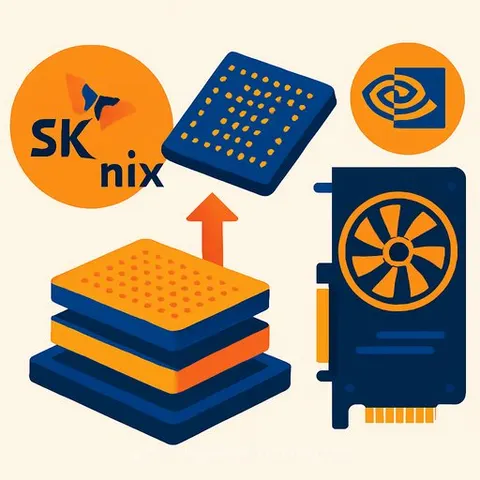
SK Hynix Hits Record High After HBM4 Breakthrough: What It Means for AI Engineering
SK Hynix shares jumped 7% to an all-time high after the company said it finished development of HBM4, the next generation of high-bandwidth memory used in AI accelerators. The stock is up more than 90% over the past year, putting the company at roughly $170 billion in market value. The rally followed an eight-day winning streak, driven by strong sentiment across the AI supply chain. SK Hynix is currently the primary HBM supplier for Nvidia, having overtaken a larger rival in this category.
Why HBM4 matters for engineering teams
- Higher memory bandwidth and capacity reduce GPU stalls, improving training throughput and inference latency.
- Larger stacks and denser packaging enable bigger models and longer sequence lengths per device before falling back to aggressive sharding.
- Better energy efficiency at the memory layer can lower thermal constraints, allowing steadier sustained performance.
- Tighter integration with advanced packaging (e.g., 2.5D/3D) helps keep data closer to compute, easing the memory wall.
Practical effects on your stack
- Batch sizing and sequence length: Expect headroom to increase; re-tune batch/grad accumulation to saturate newer accelerators.
- Parallelism strategy: Revisit tensor/pipeline sharding and activation checkpointing-some workarounds may no longer be worth the overhead.
- Kernel efficiency: Use fused kernels and memory-aware ops to fully utilize bandwidth; profile with Nsight/rocProfiler equivalents.
- I/O shifts: As on-package bandwidth climbs, bottlenecks move to interconnect and storage. Plan for faster GPU-GPU links and higher SSD throughput.
- Thermals and uptime: Improved energy characteristics at the memory layer can stabilize clocks under sustained load-verify with long-haul burn tests.
Procurement and timing
- HBM supply has been tight industry-wide; engage vendors early for capacity planning on next-gen accelerators.
- Expect HBM4 to appear first in top-tier data center GPUs; align model roadmaps and cluster upgrades with vendor release cycles.
- Keep abstractions portable (CUDA, ROCm, SYCL where relevant) so you can adopt new memory tiers without large refactors.
What to do this quarter
- Profile current workloads for memory-bound vs compute-bound behavior; list candidates that benefit most from higher bandwidth.
- Prototype with larger batch/seq settings on HBM3e hardware to estimate uplift and guide capacity asks for HBM4 nodes.
- Audit datacenter constraints-interconnect, NVMe, and cooling-to avoid shifting bottlenecks when GPUs get faster memory.
For background on HBM standards, see JEDEC's overview of High-Bandwidth Memory. For context on GPU memory bandwidth demands, review Nvidia's data center GPU documentation on memory throughput and topology here.
If you're upskilling your team for next-gen AI systems, explore AI courses for developers that focus on production training, inference, and systems optimization.
Bottom line
HBM4 is a clear step forward for GPU memory. For engineering leaders, the value shows up in higher throughput, simplified parallelism, and better efficiency-provided the rest of the stack keeps up. Start profiling, re-tune your configs, and make procurement moves now so you're ready when HBM4 hardware lands.