
AI news ·
Home Depot expands AI assistant across US stores, moving retail AI into physical spaces
Home Depot is bringing its Magic Apron AI assistant to over 2,000 US stores to guide in-aisle shopping via smartphones using real-time inventory and wayfinding data.
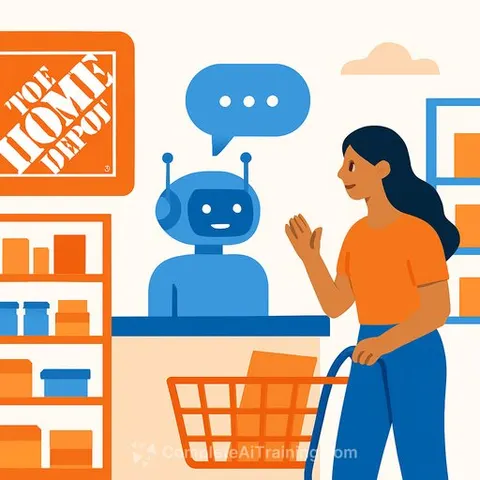
Home Depot is rolling out its Magic Apron AI assistant to more than 2,000 US stores, moving AI-powered shopping tools from screens onto the physical shop floor. The expansion, announced September 4, 2026, signals a shift in how retailers use AI-not to replace physical stores but to connect digital product data with in-aisle customer decisions.
The assistant accepts text, voice, and image queries. It draws on localized store knowledge, including inventory levels, product locations, and wayfinding data, to guide customers through the store via their smartphones. "The AI assistant connects conversational AI with inventory, product data, and store wayfinding, enabling in-aisle assistance via smartphones," Home Depot said.
Physical retail becomes the new AI frontier
A common assumption is that AI commerce means ecommerce. Home Depot's move challenges that view. The chain is using omnichannel AI to link product data, inventory systems, and store infrastructure into a single customer journey that starts with digital assistance and ends at the right shelf.
This approach matters because it changes where AI adds value. Instead of sitting behind a website search bar, the technology now helps customers make faster decisions while standing in the aisle. Store associates benefit too. Generative AI gives them enhanced product knowledge and decision support, which can improve how they serve customers on the spot.
Experts estimate up to 60% of retail tasks-from first-line managers to entry-level employees-could be automated. But the applications driving this shift come largely from upstream functions like marketing and merchandising, not from store operators themselves.
AI moves up the marketing funnel
AI's influence on the customer journey begins long before the point of purchase. Prospecting and lead generation have become key adoption areas. By analyzing customer and market data, AI helps brands identify high-value audiences and deliver more relevant content and offers at scale.
This creates a tighter connection between marketing and retail operations. A customer might first encounter a product through an AI-personalized ad, then receive tailored guidance when they walk into the store. The opportunity is not simply automating individual tasks-it is using AI to connect different stages of the customer journey. For marketing teams building these strategies, AI for Marketing skills are becoming central to campaign design and measurement.
Unified commerce ties the channels together
Traditional omnichannel setups often run websites, apps, and physical stores on separate systems. Unified commerce changes that by connecting customer, product, pricing, and inventory information in real time across all channels. For AI to bridge online and in-store experiences, access to this real-time data is essential.
A McKinsey report found that AI's biggest potential lies across customer experience, growth, and productivity. Hyper-personalization is the common thread. When retailers can tailor content and messaging at scale across both digital and physical touchpoints, they create the consistent experience customers now expect.
Retail managers overseeing these integrations need to understand both the technology and the operational shift. Training pathways like AI for Retail Managers cover the inventory optimization, store automation, and customer analytics skills that underpin physical AI deployments.
Measurement becomes the new challenge
As AI embeds into physical stores and influences product discovery earlier in the funnel, customer journeys become harder to track through traditional digital touchpoints. Marketers must understand not just where the purchase happened, but how AI shaped the customer's path along the way.
These questions will be central to discussions at industry events, including the Digital Marketing World Forum North America 2026 in New York. The challenge is practical: if a customer uses an AI assistant in-aisle to find a product they first saw in a personalized ad, which channel gets credit?
Why this matters for marketers
Home Depot's expansion makes one thing clear: AI is becoming part of the retail environment itself, not a separate digital channel. For marketers, this makes the customer journey more fluid-and harder to influence and measure with existing attribution models. The brands that adapt their measurement frameworks to account for AI's role across physical and digital touchpoints will have an edge in understanding what actually drives conversion. The battleground is no longer just on the screen. It is in the aisle.