
AI news ·
Hong Kong HR leaders say AI value depends on people, not tools
88% of Hong Kong organisations have updated fewer than half their roles for AI, and nearly 40% of time saved is lost to rework. HR leaders say redesigning jobs and training, not buying tools, is where the real value lies.
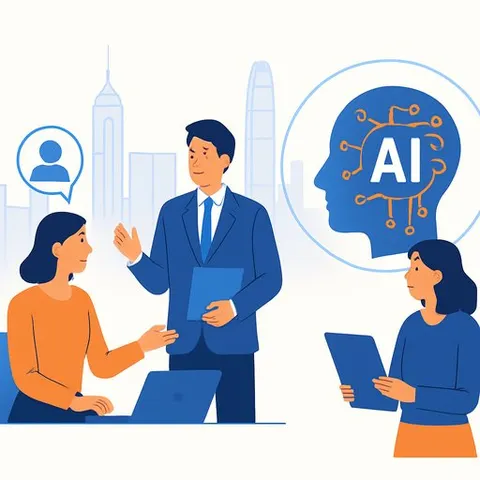
Most Hong Kong companies have already bought the AI tools. What they haven't done is redesign the work those tools are supposed to improve - and that gap is where the value leaks.
Recent research by Workday found that while employees are saving time with AI, much of that benefit is lost to rework: fixing mistakes, rewriting content, and double-checking outputs from generic tools. Only 38% of employees doing the most rework said they had access to skills training, and 88% of organisations in Hong Kong reported that fewer than half their roles had been updated to reflect AI capabilities.
The problem isn't technology. It's workforce readiness. Two Hong Kong HR leaders - Kris Lui, a global HR leader, and Sarah Cheuk, Head of People at Fano - say organisations that treat AI as an IT rollout will keep falling short.
Tools alone don't deliver value
"Few companies spend quality time to redesign the organisation holistically - from the business strategy to the implied work and structure, process and systems, people capability, rewards, and culture," Lui said. "This gap is where the value leaks. It echoes the Workday study which showed that nearly 40% of the time AI saves is lost to rework because people run 2026 tools inside 2015 jobs."
Cheuk warns against pushing AI implementation too aggressively in pursuit of immediate ROI.
"While the enthusiasm is understandable, sustainable AI adoption requires more than just deploying the right tools," she said. "It demands equal attention to your people's skills, readiness, and buy-in across the organisation."
Both leaders also caution against assuming AI can replace everything. Successful integration requires identifying where AI genuinely adds value and where human judgement remains irreplaceable - less about racing to automate, more about thoughtfully augmenting how people work.
Early experiments show what works
Cheuk's first significant experiment at Fano was integrating an AI-powered meeting note-taker into performance appraisals and interviews. The result: HR and interviewers stopped taking notes and started engaging.
"Our HR colleagues and interviewers can engage more meaningfully with candidates and employees, and focus on what truly matters - the human dialogue," she said. "The depth and quality of our discussions noticeably improved."
Lui has been using AI since 2019, when she was Asia Pacific Human Resources Vice President at Vertiv. Her team deployed a robot called "Alice" to call and attract candidates to recruitment events in China. Alice saved 4,000 man hours for the talent acquisition team, who then pivoted to higher-value work with business leaders and universities.
Both leaders agree human oversight is what makes AI work. "No matter how well trained the AI was, a human in the loop was still needed at a certain stage to ensure the desired outcome was delivered consistently," Lui said. "AI scales at the speed of capability and trust, not licences. Build the people, and the tool delivers."
For HR professionals looking to build those skills, resources like AI for Human Resources courses and the AI Learning Path for CHROs offer structured approaches to closing the capability gap.
Preparedness starts with context
According to the Hong Kong Productivity Council's 2025 AI Readiness in Workplace Survey, 88% of employees in surveyed companies already use AI tools in their day-to-day work. Yet a lack of AI expertise, training, and readiness remains a prominent hurdle.
Cheuk believes building the right context - with courage and an open mind - is the first step. Transparent communication with stakeholders throughout the journey matters just as much.
"Organisations that are willing to embrace new technology - and proactively explore how it can enhance their operations - position themselves far ahead of those that hesitate," she said. "When employees understand the 'why' behind the change and see how it benefits their day-to-day work, adoption becomes a genuine win-win rather than a top-down mandate."
Lui argues that human skills, not technical fluency, are the real competitive advantage.
"The scarce skill isn't prompting," she said. "The competitive advantages that humans still have are inspirational leadership, strategic thinking, collaboration, communication, authentic creativity, and ethical judgement. People still check AI output as carefully as a colleague's by exercising sound judgement."
She focuses on equipping people with hands-on experimentation and psychological safety. "AI tools become obsolete very quickly. I treat them like toys. Make the learning experience fun and fulfilling. Productivity will then come."
AI is everyone's job
Should HR, IT, or a chief AI officer own AI adoption? Lui argues the responsibility cannot rest with a single executive.
"If a company creates a chief AI officer role and expects the job holder to lead and transform all AI-related matters in the whole company, the company over-simplifies the matter," she said. "AI is everyone's accountability and agility. All functions and people across all levels and markets should identify the need to explore, experiment, learn fast, adjust, and excel."
She suggests organisations consider a "chief agent officer" - a role managing agentic AI across functions and reporting to the CEO. HR's part is to lead organisation design and capability building.
Why this matters for HR professionals
The practical takeaway: HR teams should stop measuring AI success by tool adoption or hours saved. Instead, audit whether job roles, workflows, and training have been updated to match the new tools. The organisations that close that gap - not the ones with the most licences - will see the returns.
"AI is an equaliser - it comes once in a generation and everyone starts at the same line regardless of your age, seniority, gender, and nationality," Lui said. "The winners won't be those with the most tools, but those who redesign the business strategy and the corresponding organisational capability to deliver it phase by phase."