
AI news ·
Hopes and Fears for Trump’s AI Action Plan: What America Stands to Gain or Lose
President Trump plans a new AI action plan focusing on competitiveness and security, but concerns arise over potential control by private firms and weakened regulations. The future of AI depends on open research, public infrastructure, and fairness.
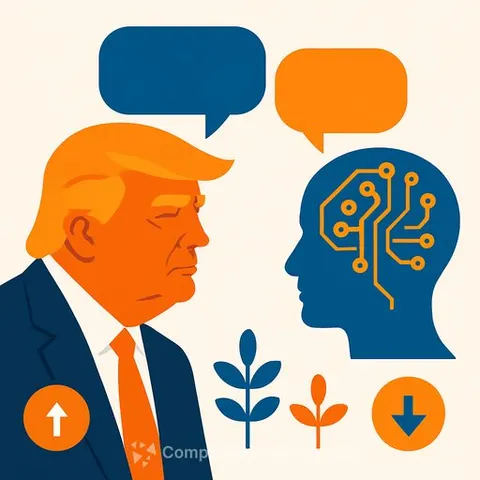
When Donald Trump returned to the White House with strong backing from tech billionaires, one of his first moves was to rescind the Biden administration’s executive orders on artificial intelligence. Soon, President Trump plans to unveil a new AI action plan, expected to include fresh executive orders. This “Winning the AI Race” plan will reflect over 10,000 public comments collected by the White House Office of Science and Technology Policy (OSTP). Many, including civil society groups, hope the plan will promote human flourishing, economic competitiveness, and national security.
Yet, a closer look at policy proposals, recent congressional actions, media reports, and statements from Trump advisors raises concerns. There is a real risk that the plan will fall short of its goals, ceding control of AI to the private sector and missing a crucial opportunity for leadership in this critical technology. Below, we explore what positive steps the plan might include—and where the dangers lie.
Priorities for an Effective AI Action Plan
An effective AI strategy should focus on four key priorities:
- Protect rights to read and learn that enable AI training.
- Support open-source, collaborative research and development.
- Build and maintain public AI infrastructure to prevent monopolies.
- Develop standards for AI explainability and transparency to build trust.
Winning the AI race means creating an open, innovative, and competitive environment that Americans trust. Without these priorities, AI development risks becoming dominated by a few large tech firms, producing opaque systems that breed distrust and cause harm. True leadership means technology that fosters shared prosperity, reflects diverse values, and is understandable. Speed alone is not enough.
Reasons for Hope
Prioritizing AI Research and Investment in Science
One promising area is a focus on AI research and development. Sustained public investment in research institutions like universities and national labs is essential to maintain U.S. leadership. Unlike many past technologies, major AI advances have come from private and nonprofit labs, highlighting the need to strengthen public research capacities.
Despite recent cuts to scientific funding, the action plan could reverse this trend. Experts across sectors agree that government support for advanced computing resources, datasets, and research funding is crucial. For instance, Google has emphasized increasing funding for early-stage research and broadening access to essential AI tools for scientists.
Institutions like Stanford and organizations such as the Federation of American Scientists stress expanding resources like the National AI Research Resource (NAIRR) to provide the compute, data, and training needed for breakthroughs. These investments would not only advance competitiveness but also ensure AI benefits the public broadly.
Embracing Open Source, Especially in Government Procurement
The administration could also support open-source AI development. Open-source AI improves security, transparency, and accessibility, accelerating innovation and strengthening national competitiveness. Prioritizing open-source models in federal procurement would leverage government scale to encourage broader development.
Many groups support this approach, including civil society organizations, academic experts, and even some AI companies. Meta advocates for preferring open-source AI in government use to enhance security and reduce costs. OpenAI has also suggested exporting open-source models to maintain U.S. leadership globally. An open-source focus would signal that American AI leadership values collaboration and freedom, rather than secrecy and closed systems.
Well-Founded Fears
Attack on Diversity and Equity Disguised as Neutrality
Reports indicate the White House may issue an executive order requiring AI contractors to produce politically neutral and unbiased models, targeting what it calls “woke” AI. However, claims of neutrality often mask ideological agendas that undermine diversity and equity.
Government policy can and should reflect democratic values, including fairness and inclusivity. The previous Biden administration’s order ensured AI systems used by federal agencies avoided bias and discrimination in critical areas like housing and healthcare. Repealing such policies isn’t neutrality—it risks imposing narrower, exclusionary ideologies.
Legislation attempts, such as Senator Ted Cruz’s proposed “anti-woke” amendments, explicitly barred efforts to design AI that prevents disparate impacts or promotes inclusivity. Although defeated, these proposals reveal a troubling agenda against equity principles.
The Trump administration’s history of dismantling diversity and inclusion programs, and its promotion of discriminatory policies against marginalized groups, further undermine claims of neutrality. True American values mean embracing diversity as strength and building AI that reflects fairness, not discrimination.
Legal Loopholes That Put the Public at Risk
There is concern the action plan will create broad legal loopholes for AI companies, undermining existing laws and blocking new regulations. The administration’s deregulatory stance, combined with industry lobbying, may push for preemption of state laws, voluntary standards, and “regulatory sandboxes” that exempt AI firms from accountability.
While flexible regulation and experimentation have a place, they must be paired with enforceable rules. States have long served as innovators in consumer protection and digital rights; removing their authority without replacing it with strong federal standards would leave the public unprotected.
Voluntary industry standards alone cannot ensure safety or fairness. Existing civil rights and consumer protection laws must be enforced, and companies held liable for harms caused by their AI. Accountability is key to building public trust and driving genuine innovation.
Risk of Selling Out on AI Infrastructure
Another worry is that the administration will promote AI infrastructure projects that primarily benefit private interests, missing opportunities for public investment. Comments submitted to OSTP show Big Tech’s strong push for data centers and power infrastructure, but recent budget decisions suggest little support for sustainable, public-oriented infrastructure.
Public AI infrastructure—such as shared computing resources and data platforms—can prevent monopolies and foster competition. Organizations like the Open Markets Institute, Mozilla, and academic groups have called for public investment in AI infrastructure to boost national security and innovation.
Yet, the administration’s enthusiasm for private sector deals and fossil fuel handouts raises the risk that federal resources will be handed over without meaningful returns for the public. This would be a missed opportunity to build a foundation for long-term AI leadership.
For those interested in expanding their AI knowledge and skills, exploring up-to-date AI courses can provide practical insights into the evolving landscape.
Ultimately, the upcoming AI action plan is a critical moment. It can either set a course for an open, fair, and competitive AI future—or deepen existing problems. The stakes are high, and the choices made now will shape how AI serves the American people for years to come.