
AI news ·
Hospitals shift from isolated AI tools to connected care orchestration
With 97 percent of hospital data unused, care orchestration shifts focus from accumulating algorithms to connecting workflows. This routes information directly to care teams.
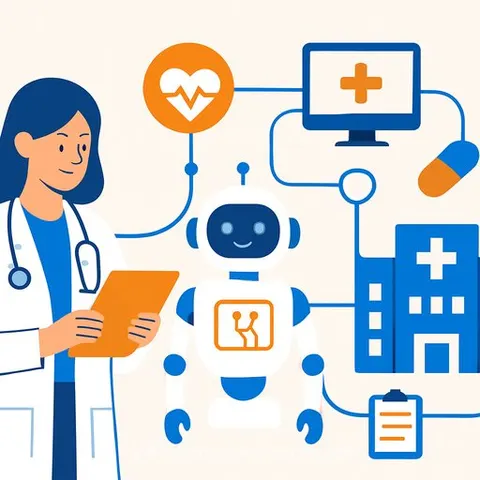
An estimated 97 percent of data produced by hospitals goes unused. Yet the constraint holding many health systems back isn't a shortage of information-it's the opposite. Hospitals generate extraordinary amounts of data every day, but too little reaches the right clinician, in the right workflow, at the right moment. The next era of healthcare AI, according to health system leaders, will not be defined by the organization with the most algorithms, but by how effectively intelligence connects across the patient's journey.
The daily experience of delivering care, say clinicians, feels fragmented. Technology has advanced, platforms have been built, and infrastructure has expanded, but the connections between them remain missing at scale. The result is friction: a radiologist works in one workflow, a cardiologist in another, a care coordinator tries to bridge both, and an administrator looks for the operational picture across all of them.
The push toward care orchestration aims to solve this by moving the right information, task, or action to the right person at the appropriate point in the care journey. This shift in AI for Healthcare is about connecting people, data, devices, diagnostics, software, and workflows so care teams can act with fuller context. A point solution supports a single moment; orchestration connects the moments.
What is care orchestration?
Interoperability allows systems to exchange information. Integration brings technology together. Care orchestration goes further: it ensures that the right information, task, or action reaches the right person at the appropriate point in the care journey. It connects the dots across specialties, devices, and software environments so that each team can work from a more complete picture.
Consider a patient moving from an initial scan to diagnosis, treatment planning, and follow-up. Each step may involve a different specialist, device, and clinical team. The opportunity is not to apply AI at each individual step, but to carry the relevant context forward so that no one is working in isolation.
Start with the clinical workflow, not the hype
The most effective AI strategy starts with practical questions: Where is healthcare harder than it needs to be? Where are clinicians spending time on repetitive tasks? Where is information hard to find? Which systems can be connected to share information more efficiently? Where is patient care delayed?
AI should be used where it addresses a clearly defined clinical, operational, or patient need, not simply because it is available. And clinicians agree the need is real. While Deloitte's 2026 Global Health Care Outlook found that only about 30 percent of health systems report running generative AI at scale and just 2 percent have deployed it across the enterprise, Doximity's 2026 State of AI in Medicine Report, drawing on more than 3,100 U.S. physicians, found that over 90 percent are already using AI or are interested in doing so. When AI fits into the way clinicians work, it earns its place. When it adds complexity, it risks becoming one more tool to manage.
Why care orchestration is human, enhanced by AI
Care orchestration is fundamentally a human idea. The goal is not to place technology at the center of care, but to help people work with greater clarity, context, and coordination. The questions that matter are human ones: How can AI help clinicians spend less time on administrative tasks and more time caring for patients? How can AI help care teams see, diagnose, and treat what matters most, sooner? How can AI create a more connected experience for patients?
Trust will ultimately determine which technologies scale. Clinicians need confidence that tools are designed for real clinical use. Health systems need confidence that they can be implemented responsibly within complex operational and technology environments. Patients need confidence that their care keeps the human connection at its center. Trust depends on governance, transparency, interoperability, and careful implementation-with partnership across everyone who delivers care.
Why this matters for healthcare professionals
For clinicians and health system leaders, the message is clear: the next phase of AI in healthcare will reward organizations that connect data and workflows, not those that simply accumulate more algorithms. The practical takeaway is to prioritize AI tools that integrate into existing clinical workflows, earn the trust of care teams, and solve specific, well-defined problems-such as reducing administrative burden or surfacing missing patient context. The measure of success is not adoption alone, but whether technology helps care teams work together more effectively.