
AI news ·
How AI is Helping Preserve and Promote Bahasa Indonesia Amid Globalization
AI supports Bahasa Indonesia by offering interactive learning tools and boosting its online presence through translation and content generation. This helps the language stay relevant amid global English use.
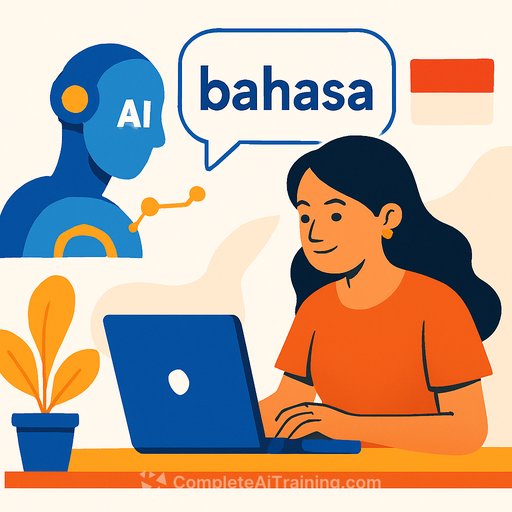
The Role of AI in Preserving Bahasa Indonesia
Artificial intelligence (AI) is increasingly influencing various fields, including language preservation. As globalization encourages the use of English, Bahasa Indonesia faces challenges in maintaining its presence, especially among younger generations who often mix English phrases in daily speech. AI offers practical solutions to support and promote Bahasa Indonesia in contemporary settings.
Learning Bahasa Indonesia has become more accessible and engaging with AI-powered tools. Instead of traditional, monotonous methods, learners can interact with AI systems that understand the language and provide instant feedback. Some of these tools include:
- Speech practice applications powered by AI.
- Grammar and spelling checkers tailored for Bahasa Indonesia.
- Synonym and antonym finders to enrich vocabulary.
AI also plays a key role in increasing Bahasa Indonesia's visibility online. Since much digital content is predominantly in English, AI helps by:
- Automatically generating articles in Bahasa Indonesia.
- Translating foreign content smoothly into Bahasa Indonesia.
- Providing fast subtitles for videos in Bahasa Indonesia.
Virtual assistants that understand and communicate in Bahasa Indonesia improve user experience across many sectors, from government services to customer support. This integration encourages wider use of the language in digital environments and everyday interactions.
One notable advancement is the creation of AI-powered digital dictionaries. Students and writers no longer need to rely on bulky print dictionaries; they can simply ask an AI for word meanings along with synonyms, antonyms, origins, and example sentences. For instance, querying the word "berkelakar" results in a contextual explanation that goes beyond rigid definitions.
This works because AI uses large datasets combined with Natural Language Processing (NLP) and machine learning. These technologies allow AI to understand context and provide relevant answers, making language learning more efficient for students and content creators alike.
However, AI is not flawless. If the training data contains errors, the AI’s output may be misleading. That’s why dedicated teams must continuously improve AI systems to ensure they capture language nuances and communicate effectively. AI should be viewed as a helpful tool, complementing human insight rather than replacing it.
When used wisely, AI has the potential to help Bahasa Indonesia grow and adapt, supporting education, content creation, and public services.
Concerns Regarding the Indonesian Language Literacy Test
The Ministry of Higher Education, Science, and Technology (Kemdiktisaintek) recently addressed complaints about the Indonesian Language Literacy (LBI) subtest in the 2025 Computer-Based Writing Examination (UTBK) for the National Selection for New Student Admissions (SNPMB).
Some participants reported that certain questions did not align with the LBI material. For example, Muhammad Hafidz, a student who took the UTBK at Gadjah Mada University (UGM), pointed out questions about the chemical elements in cow's milk and Newton's theory of liquidation. These topics were not covered in his LBI study materials, causing confusion.
Togar Mangihut Simatupang, Secretary-General of Kemdiktisaintek, responded by explaining that the UTBK questions undergo thorough testing. The focus is on assessing analytical literacy rather than simple factual recall. He acknowledged the feedback from students and assured that it will guide improvements in future tests.
The LBI test in UTBK SNBT 2025 consists of 30 questions to be completed in 42.5 minutes. Togar emphasized the importance of maintaining literacy and language as tools for scientific communication while addressing concerns.
Separately, Aqeela Soraya Elfauzan, a student from Madrasah Tsanawiyah Negeri Padang Panjang, submitted her final report for the 2024/2025 academic year on May 7, 2025, marking an important milestone in her education.
As education and technology progress, AI’s collaboration with language learning and testing will be vital to ensuring Bahasa Indonesia remains relevant and respected. Integrating AI into educational tools and public services can help the language adapt and thrive in a global context.