
AI news ·
How AI is Revolutionizing Inclusive Education and Empowering Saudi Arabia’s Vision 2030 Goals
AI is transforming education in Saudi Arabia by personalizing learning and supporting students with disabilities. This aligns with Vision 2030’s goal for inclusive, future-ready education.
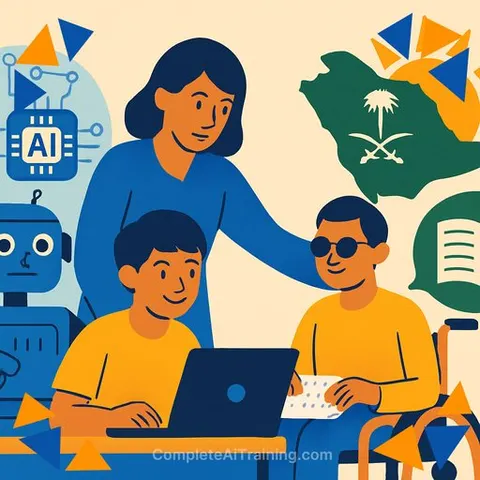
AI Tools Empower Students with Disabilities and Transform Education in Saudi Arabia
Artificial intelligence is becoming central to Saudi Arabia’s education reform under Vision 2030. Across the Kingdom, AI is reshaping classrooms by personalizing learning, streamlining administrative tasks, and providing new ways for students of all abilities to engage with their studies.
Students like Abdullah Mohammed, a law student at Imam Mohammad ibn Saud Islamic University, report that AI tools such as tutoring systems and study apps have made learning more efficient and accessible. However, he also cautions that some AI tools offer quick answers without encouraging critical thinking, emphasizing the need for balanced use.
Personalized Learning and Inclusive Education
Professor Abdulrahman Al-Motrif of King Saud University highlights AI’s alignment with Vision 2030 goals. AI enables personalized learning by analyzing student performance in real-time, allowing educators to adjust instruction to individual needs. This approach improves student outcomes and supports the Kingdom’s efforts to build a future-ready workforce.
AI also advances inclusive education by reaching remote communities and supporting students with special needs. Technologies like speech-to-text software, adaptive interfaces, and screen-reading tools are opening doors for students with disabilities. For example, King Saud University’s collaboration with AI developers has produced tools that convert written content into audio for visually impaired learners.
Leading Platforms and Evidence of Success
Platforms such as Alef Education and Classera are putting AI into practice. They use real-time analytics to adapt content based on each student’s learning style, proficiency, and pace. Classera’s gamified Learning Management System app, C-Kids, supports young learners from kindergarten through Grade 3.
A study by Alef Education found that students using AI-enhanced platforms improved their academic performance by 25% over one semester. These results show how AI can boost learning outcomes through personalization.
Changing Roles for Educators
AI is also streamlining administrative tasks. Platforms like Madrasati use AI to monitor attendance, track engagement, and assess academic progress. This automation frees educators to concentrate more on teaching and mentoring.
Rather than replacing teachers, AI is redefining their roles. Educators in AI-supported classrooms act as facilitators and mentors, using AI insights to identify learning gaps and provide human connection within a digital environment. Madrasati’s success during the COVID-19 pandemic was recognized by UNESCO as an innovative educational model.
Challenges and the Path Forward
One major challenge is the lack of Arabic-language digital content, which makes up only 1.2% of global resources. This shortage limits AI’s effectiveness, as most systems rely on data-rich environments. To overcome this, Saudi Arabia needs to digitize traditional educational materials, encourage Arabic content creation, and develop AI algorithms specific to the Arabic language.
Some universities, including Imam Abdulrahman bin Faisal University and King Abdulaziz University, have already adopted AI-powered systems to personalize instruction and monitor student progress. Their success shows AI is more than a technological upgrade—it is changing how education is delivered.
Conclusion
By integrating AI thoughtfully, Saudi Arabia can provide personalized, inclusive, and high-quality education that supports Vision 2030 goals. Achieving this requires investment, collaboration, and a focus on aligning technology with pedagogy and policy. With sustained effort, AI can become the foundation of a dynamic education system that prepares all learners for the challenges of the digital age.
For educators interested in exploring AI’s potential in education, resources and courses are available at Complete AI Training.