
AI news ·
Illinois and Connecticut adopt artificial intelligence employment laws as New York audit finds enforcement gaps
NYC Law 144 and new rules in Illinois and Connecticut mandate AI hiring notices by 2027. Companies must update automated employment tools to comply.
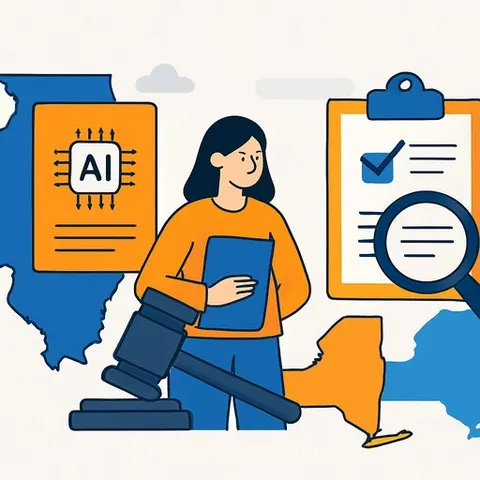
Three state-level actions are reshaping the legal landscape for AI in employment decisions. Illinois has amended its Human Rights Act to require AI-specific notice and prohibit discriminatory AI use starting January 1, 2026. A New York State Comptroller audit released in December 2025 found significant enforcement gaps under New York City's Local Law 144, the automated employment decision tools (AEDT) law in effect since July 2023. Connecticut's SB5, effective October 1, 2027, establishes a disclosure-focused AEDT framework. For employers and their legal counsel, these developments mean AI-driven hiring, promotion, and discipline tools now demand jurisdiction-specific governance, documentation, and communication.
Illinois: Notice and Anti-Discrimination Under HB 3773
House Bill 3773 amends the Illinois Human Rights Act to make it a civil rights violation to use AI in employment decisions if the AI has a discriminatory effect or if the employer fails to notify employees that AI is being used. The law covers IHRA employers-generally those with at least one employee in Illinois during 20 or more weeks a year-and applies to a broad range of AI, including generative AI embedded in software products.
The Illinois Department of Human Rights (IDHR) has circulated draft rules (Subpart J) that outline a detailed notice regime. Notices would be required annually to current employees, within 30 days of adopting a new AI system, and in job postings for candidates. The draft rules specify multi-channel delivery (handbook, workplace posting, website, job postings), content identifying the tool and vendor, data categories processed, and a contact for questions. Notices must be in plain language, available in commonly spoken workforce languages, and retained for four years. While the hearing on the draft rules has been postponed, the proposal signals a compliance lift that goes well beyond a simple disclosure.
New York City: Enforcement Gaps Under Local Law 144
New York City's Local Law 144 requires employers to obtain an annual independent bias audit before using an AEDT, publish a summary, and provide candidate notice. The New York State Comptroller's audit, covering July 2023 through June 2025, found that the Department of Consumer and Worker Protection (DCWP) had not designed an effective enforcement system. Complaint intake was weak, proactive website reviews missed potential non-compliance, technical expertise was underused, and outreach to employers was not sustained.
The audit recommended that DCWP strengthen complaint routing, broaden proactive reviews, and consistently use the Office of Technology and Innovation's support when evaluating tools. For employers, the findings are a warning: quiet enforcement does not equal low risk. If DCWP implements the recommendations, LL144 compliance could tighten quickly.
Connecticut: SB5 and Disclosure Requirements
Connecticut's SB5, effective October 1, 2027, defines AEDT broadly and requires deployers to provide written notice to applicants and employees when AEDT output is a substantial factor in an employment decision. The notice must include the tool's trade name, purpose, categories of personal data analyzed, data sources, and the deployer's contact information. Unlike New York's law, SB5 does not mandate bias audits, but evidence of anti-bias testing may be considered in discrimination claims.
The statute also amends Connecticut's human rights law to clarify that using an AEDT is not a defense to a discrimination claim. Earlier versions of the bill that included an opt-out right and a requirement to explain adverse decisions were removed, leaving a more streamlined disclosure obligation that still demands careful vendor and data-flow documentation.
Why this matters for legal professionals
These three developments show that AI in employment is no longer a policy debate-it is a compliance obligation with jurisdiction-specific rules. Legal counsel should guide employers to inventory all AI tools touching employment decisions, prepare detailed notice packages for Illinois and Connecticut, maintain bias audit artifacts for New York City, and strengthen vendor contracts to support transparency and audit rights. For legal teams advising HR departments, staying current on these requirements is critical; resources like AI for Human Resources training can help bridge the gap between legal mandates and operational implementation. The regulatory trend points toward more granular state and local laws, making AI governance a permanent fixture in employment law practice.