
AI news ·
Indian managers seek balance as AI overuse grows in workplaces
87% of Indian enterprises use AI tools, but managers report employees outsourcing critical thinking, producing poor work, and facing burnout. Firms like Veersa and ICRA now push human review steps and AI-use policies to curb over-reliance.
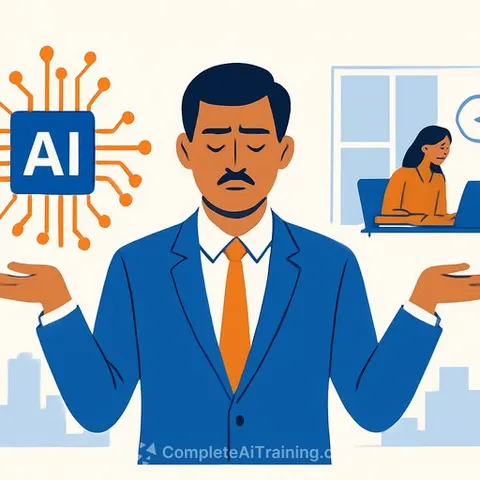
Indian companies lead the world in workplace AI adoption, with roughly 87% of enterprises actively using AI tools and four out of five employees using them multiple times a week. But managers are now confronting a less-publicized side effect: employees who outsource their thinking to AI, produce poor-quality work, and feel burnt out from the pressure to move faster.
"AI tools are very good if you're using them to accelerate your thinking, but at times people will outsource their thinking to these tools - that becomes a problem," said Vipul Taneja, co-founder and chief technology officer at Veersa Technologies, a software-services provider in Noida.
The problem shows up most often with younger, less experienced employees. Taneja said leadership encourages everyone to use AI for productivity, but the balance between efficient use and overuse is still being figured out.
Overload Is Real
Managers should watch for AI overload and related stress, said Sheetal Sandhu, Gurgaon-based Group CHRO at ICRA Ltd., a credit ratings and analytics provider. "It's for real. People are feeling burnt out," Sandhu said.
ICRA is focusing on AI augmentation rather than AI substitution. "We need to maintain our core skills - our analysis skills, our decision-making skills, and empathy. All that can't be outsourced," she said.
Tarunima Prabhakar, co-founder of Tattle Civic Technologies, has seen entry-level software engineers hand the entire process to AI and "never look at it again." That creates poor quality and an "AI blind" integrated team. She advises managers to have "a critical discussion, not just about the AI use policy but also about the AI use culture."
At Tattle, the problem surfaced when two young hires from a rural youth skills program applied AI liberally to simple tasks. "They used ChatGPT for very simple work, and it didn't help," Prabhakar said. An in-person team meeting about AI's environmental cost and potential for cognitive decline shifted perspectives, and the company created an AI use policy outlining what's allowed and what isn't.
Show, Don't Tell
Veersa hasn't created a list of dos and don'ts around AI use, because Taneja fears it could curb creativity. Instead, the company demonstrates by example how people and AI can work together.
"AI is as good as the context it gets," Taneja said. Incomplete or poorly articulated information leads to hallucination. Veersa built tools into its technology systems to catch obvious mistakes a new engineer relying solely on AI might make, and added human-in-the-loop review steps during projects. The team created a prototype and presented it as a preliminary case study to project leaders. "Slowly is increasing the adoption," Taneja said.
He stressed that team members must verify final results and understand why AI produced what it did. "At the end of the day, ownership remains in you," he said.
Evolving Situation
At large technology companies pushing aggressively for AI use, there are no standard parameters on where not to use AI, said Anubhuti Varshney, a Bengaluru-based senior IT professional at a major U.S. technology corporation. "What control you hand over and what you retain - that's a balance we're all trying to learn," she said.
When team members over-rely on AI, Varshney addresses it directly. She recalled an intern who finished a month's project in a week by using AI for everything from design to coding to data analysis. "It was all wrong," Varshney said. She asked the intern to think through her approach in advance.
AI also gives management "a new way to ask you to crunch your timelines," Varshney said. She has been asked to move up deadlines herself. "This is an evolving situation," she said.
For managers, the practical takeaway is to build review steps into workflows rather than relying on policies alone. That means requiring humans to verify AI output, discussing AI use openly in team meetings, and watching for signs that employees are handing over tasks they should be doing themselves. For practical guidance on setting those boundaries, AI for Management resources cover how to supervise AI-assisted work without losing team capabilities. And since the goal is faster work without burnout, AI Productivity training can help teams use tools to accelerate thinking rather than replace it.