
AI news ·
India’s Middle Class at a Crossroads: Will Reskilling Secure Their Future in the AI Era
India’s middle class faces job threats as AI automates routine tasks. Reskilling and embracing new roles in emerging sectors are vital for future stability and growth.
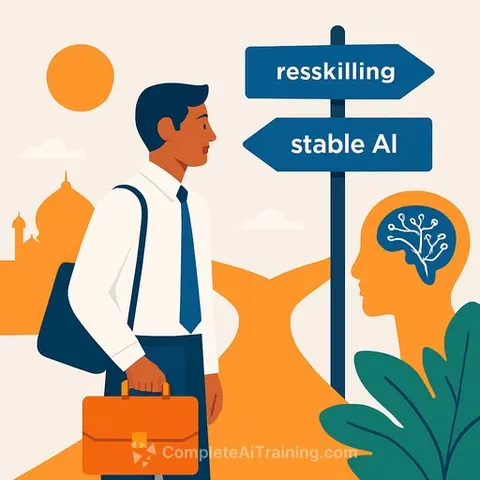
From Disruption to Reinvention: Can India’s Middle Class Survive the AI Era?
India’s middle class stands at a critical juncture as artificial intelligence (AI) reshapes many white-collar professions. Fields like IT, finance, and journalism are evolving quickly, and adapting is no longer optional. The key lies in proactive reskilling and embracing new roles that AI cannot replace.
Key Points
- AI and automation threaten many traditional middle-class jobs.
- Reskilling is essential to stay relevant in an AI-driven economy.
- New industries offer promising career paths.
- Human-AI collaboration is redefining work and boosting creativity.
India’s middle class is expanding fast, expected to make up 38% of the population by 2031 and 60% by 2047. This group has been the backbone of the country’s growth, holding steady jobs in government, IT, banking, finance, and education. These jobs provided income, dignity, and stability. Now, AI threatens to upend this foundation.
Automation targets roles involving routine, rule-based tasks—customer support, software testing, banking operations, accounting, HR, copywriting, journalism, and research. These positions have been reliable entry points for many. However, reports from NASSCOM and other industry sources show a decline in entry-level hiring as AI takes on more responsibilities.
This shift widens the gap between productivity and wages and risks deepening inequality. A small tech-savvy elite benefits from AI, while many face displacement. The middle class, once a stable economic force, is at risk of fragmentation.
To avoid this, policies must encourage inclusive growth. Reskilling programs should prepare workers for new challenges, helping them move from repetitive tasks to roles requiring judgment, creativity, and problem-solving. Entry-level jobs may vanish, but new pathways—like apprenticeships and project-based learning—can fill the gap.
Take TCS’s Xplore and Ignite programs, for example. They prepare fresh graduates with digital skills and real-world experience before they enter the workforce. The government’s National Apprenticeship Promotion Scheme (NAPS) under Skill India is creating modular training focused on automation and emerging technologies. Private platforms like Scaler Academy offer intensive, mentor-guided learning that mirrors workplace challenges.
AI doesn’t have to be a threat. Professionals who learn to work alongside AI will increase their value. Roles that emphasize empathy, complex problem-solving, and strategic thinking remain important. Emerging sectors such as green tech, AI ethics, climate adaptation, ed-tech, and digital health are prime areas for growth.
Employers and policymakers must support this transition. Retaining and retraining staff, strengthening social safety nets, expanding digital education, and investing in innovation hubs beyond major cities can spread opportunities more evenly.
India’s middle class has adapted through past challenges like economic reforms and globalization. With focused effort on human-centered skills and effective reskilling, it can not only survive the AI era but also shape its future.
For professionals in customer support, HR, IT, and development seeking to upgrade their skills for this new era, exploring courses and training designed for AI-driven roles is crucial. Platforms like Complete AI Training offer a wide range of relevant programs to help you stay ahead.