
AI news ·
Infosys restructures careers around capability portfolios as AI reshapes work
Infosys has trained over 300,000 employees in AI and digital skills, with 84% of its workforce now AI-enabled. The company is redesigning careers around capability portfolios instead of job titles, grouping roles into AI builders, AI masters, and forward-deployed engineers.
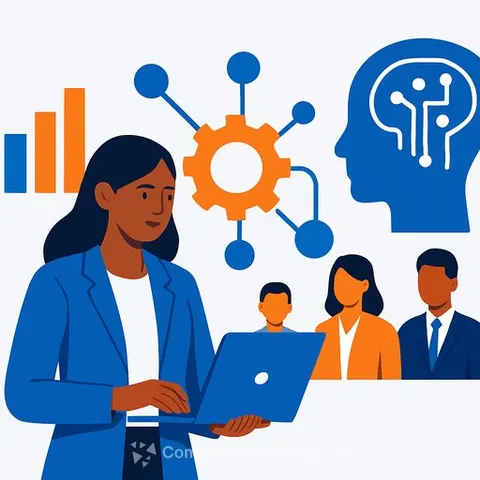
Infosys is redesigning how it organises talent, builds careers, and develops capabilities as artificial intelligence reshapes work across the enterprise. The shift moves beyond training programmes to a fundamental rethinking of the talent operating model, career architecture, and leadership expectations, according to Shaji Mathew, Chief Human Resources Officer at Infosys.
"At Infosys, we view AI transformation more than a technology shift. It is reshaping how organisations are designed, how careers evolve and how value is created," Mathew said.
The company has trained more than 300,000 employees in AI and digital skills, with over 84% of the workforce now AI-enabled. But Mathew argues the real measure is whether learning translates into stronger capabilities and business outcomes - employees applying AI in daily work, moving into new AI-led roles, and contributing to client engagements.
The move from job titles to capability portfolios
Infosys is building what Mathew calls an ambidextrous organisation - one that combines broad AI adoption with deeper engineering and domain expertise. External hiring now targets specialist programmers, full-stack engineers, and professionals with deep domain knowledge. Internally, bridge programmes and capability assessments help employees transition into emerging roles.
AI is accelerating the move away from narrowly defined jobs toward broader capability portfolios. Mathew described three emerging capability clusters: AI builders who develop contextual AI platforms and tools, AI masters who shape vision and governance across the enterprise, and forward-deployed engineers who work directly with clients to integrate AI into business environments.
"We believe future careers will be increasingly defined by skills and expertise rather than conventional job titles," Mathew said.
Why AI strategy and people strategy cannot be separated
Mathew pointed to a common organisational mistake: treating AI adoption as a standalone technology initiative. "One important learning has been that AI adoption cannot be viewed as a standalone technology initiative. To create lasting impact, organisations need to align learning, career development, talent models, and leadership with the way work itself is evolving," he said.
The primary challenge was not the technology itself. "The biggest misconception was that technology would be the primary challenge. In reality, trust, confidence, and change management proved equally important, if not more," Mathew said.
His advice to business leaders is direct: do not separate AI strategy from people strategy. "They are the same conversation," he said. Organisations that integrate AI into their operating model, career architecture, and talent development strategy will be better positioned for long-term competitiveness. For CHROs navigating this shift, structured learning pathways such as the AI Learning Path for CHROs can help build the strategic fluency needed to lead these conversations.
How performance and leadership expectations are changing
As AI handles more routine work, performance measurement is shifting from task execution to how employees combine AI fluency with business context and engineering depth. "AI can improve productivity and support better decision-making, but employees will increasingly be expected to combine AI fluency with business context, engineering depth, and sound judgment to solve complex business problems," Mathew said.
Leadership expectations are evolving in parallel. Managers must help teams adopt new ways of working and create environments where people and AI complement each other. Infosys frames this as a Human + AI approach - technology paired with human judgement, expertise, and responsible leadership. HR managers building these capabilities in their teams may find structured guidance through the AI Learning Path for HR Managers.
Why this matters for HR professionals
The Infosys approach signals a structural shift for HR leaders: workforce planning, career architecture, and performance management must evolve at the speed of AI adoption. The talent market for AI capabilities remains tight, and internal mobility becomes the primary lever when external hiring cannot keep pace. HR teams that treat upskilling as a compliance metric - counting course completions - will miss the point. The metric that matters is whether learning produces new capabilities that show up in client work and business results.