
AI news ·
Iovine and Dre defend AI music tools while criticising AI companies' communication
Jimmy Iovine and Dr. Dre say AI is a creative tool, not a threat to music, urging the industry to stop panicking. Iovine blames AI companies' "terrible communication" for the backlash, citing their poor PR as the real problem.
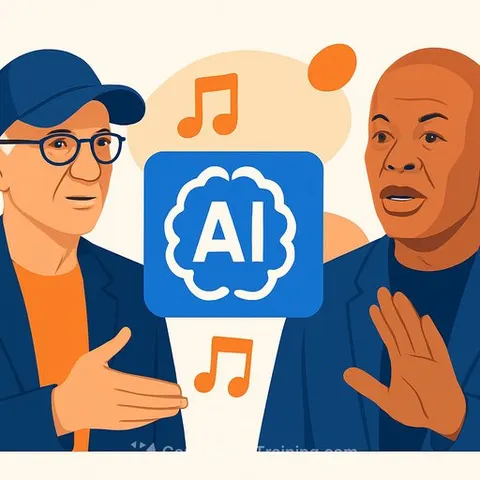
Jimmy Iovine and Dr. Dre have a message for the music industry: stop panicking about AI. In a New York Times interview, the Beats co-founders said the technology is a creative tool, not a threat - and Iovine had sharp words for the AI companies building it.
"I'm very pro-AI in music creation. I don't see the downside at all. There will be some crappy music. There's crappy music now. In the studio, when gifted people have AI, they're going to make better records," said Iovine.
He then turned his attention to the companies behind the tools. "The AI companies have the worst public relations in the history of the world… They have terrible communication skills. That's why everybody is all up in arms."
A tool, not a replacement
Dre echoed Iovine's view, framing AI as an extension of the artist's workflow rather than a substitute for it. "I don't see it as a threat. I think the only people that see it as a threat are the people who have trouble creating," he said.
"It's a new tool for creativity. Some people are afraid of learning new things. I'm embracing it. I can't wait to see what's going to happen with this…. I'm using it… as a tool to see what it would do with what I just did."
Iovine has already put money into at least one generative AI company - gaming firm Wolf Games - though he has not publicly backed any AI-music startups. Given the pair's track record with Beats, which Apple acquired for $3 billion in 2014, industry watchers may wonder whether that changes.
Why this matters for PR & Communications
Iovine's critique of AI companies is the part worth reading twice. He is not complaining about their technology. He is complaining about their communication. That distinction matters for anyone working in AI for PR & Communications: the public backlash against AI is often less about what the tools do and more about how the people building them explain it.
The takeaway is practical. If two veteran music executives can see AI's creative upside while still hammering the industry's messaging failures, then the gap between product and perception is a PR problem, not a technical one. Communicators who can translate AI's capabilities into plain language - and address fears directly - have a clear opening. That skill set is exactly what AI for Media Relations Specialists covers, and it is increasingly the difference between a story about innovation and a story about alarm.