
AI news ·
Italian bank loses $108 million in AI voice and messaging fraud targeting senior executives
A fraudster used AI-cloned voices to trick an Italian bank chairman into transferring €95 million overseas. Authorities recovered roughly €53 million, while the rest was converted into cryptocurrency.
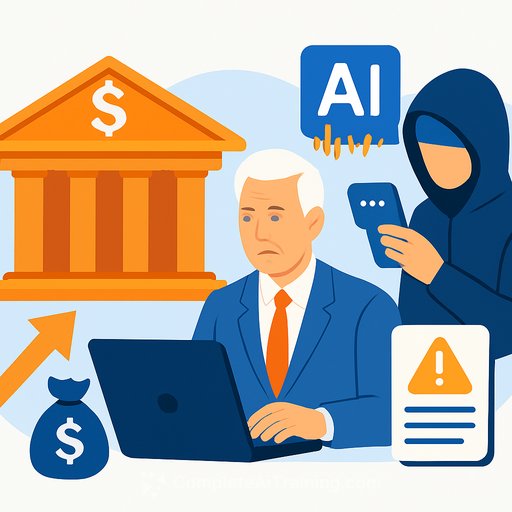
A fraudster used AI to clone voices and impersonate senior executives, tricking the chairman of Italian private bank Fideuram into transferring 95 million euros ($108 million) to overseas accounts. Milan prosecutors are investigating a foreign national living outside Europe for computer fraud, and authorities have recovered roughly €53 million so far - the rest was moved abroad and converted into cryptocurrency.
The scheme began with a WhatsApp message to Paolo Molesini, then chair of Fideuram, which appeared to come from Intesa Sanpaolo CEO Carlo Messina. The message sought urgent help with an overseas transaction. A follow-up phone call used an AI-cloned voice mimicking a senior lawyer at an associated law firm. Believing the request was genuine, Molesini instructed his finance department to arrange a series of transfers to accounts mainly in China and Hong Kong.
The incident follows a 2024 case in which an employee at Hong Kong engineering firm Arup transferred $25 million after joining a video call populated by deepfaked executives. Together, the two cases show how AI impersonation attacks on senior leadership have moved from theoretical risk to multi-million-dollar operational reality.
identifAI report warns of escalating deepfake fraud
A new report from Italian deepfake detection provider identifAI underscores that most businesses remain underprepared. The report cites a Deloitte projection that generative AI could drive U.S. fraud losses to $40 billion by 2027. It also points to the 2024 FTC Impersonation Rule, which gives regulators power to penalize entities that use AI to falsely pose as businesses or government agencies, as a tool that could help address the problem.
"The shift from theoretical risk to multi-million-dollar damages - exemplified by complex impersonation attacks targeting C-level executives - demands immediate alignment with emerging frameworks like the 2024 FTC Impersonation Rule," the report states.
Where deepfake fraud hits hardest
Private individuals top the target distribution at 18.2 percent, followed by corporate entities at 15.8 percent. Public figures account for 6.2 percent and business executives 4 percent. A large portion - 55.8 percent - falls into an unspecified category due to missing metadata or targets outside primary classifications.
Geographically, the United States dominates at 34 percent of incidents. India is a distant second at 7.73 percent. On social media, X leads at 42.1 percent of deepfake fraud-related activity, followed by LinkedIn at 14.5 percent, Facebook at 12.8 percent, TikTok at 12.5 percent, and YouTube at 8.3 percent.
"Attackers heavily leverage platforms like LinkedIn to scrape high-fidelity audio and video of senior leadership, which are subsequently fed into open-source generative models to craft highly convincing impersonation attacks," identifAI said.
Why this matters for finance, insurance, and communications teams
Finance and insurance professionals face direct exposure: payment authorization workflows built on trust and verbal confirmation are now attack vectors. A cloned voice and a WhatsApp message were enough to move €95 million. For communications and PR leaders, the reputational risk compounds the financial damage - a public disclosure of executive impersonation erodes client and investor confidence.
identifAI's recommendation is concrete: organizations must move past legacy verification protocols and implement multi-layered cryptographic media authentication alongside continuous behavioral biometric defenses. The Milan and Hong Kong cases are not outliers. They are early signals of industrialized, AI-driven fraud operations that security teams need to treat as a permanent feature of the threat environment.