
AI news ·
Jensen Huang’s Advice for Students: How Asking Better AI Questions Can Boost Your Career
Nvidia CEO Jensen Huang urges students to learn AI skills to boost careers. Crafting clear, precise prompts is key to getting effective AI assistance.
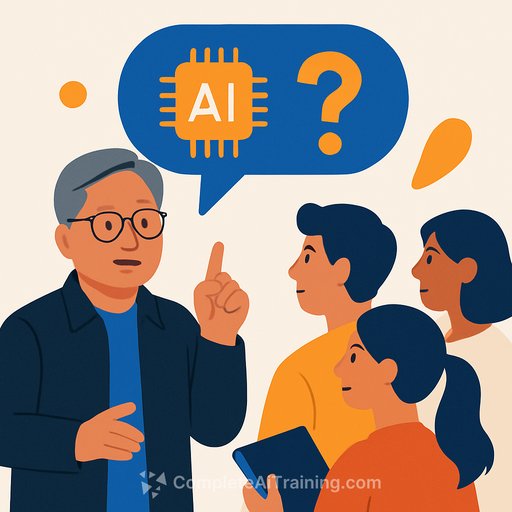
Jensen Huang on Using AI for Career Success
Jensen Huang, President and CEO of Nvidia, recently shared his perspective on the role of AI in career development during the Hill and Valley Forum at the U.S. Capitol in Washington, DC.
If Huang were a student today, he would focus on learning AI to gain an advantage in any career. “The first thing I would do is to learn AI,” he said in a January interview. He mentioned popular AI tools like ChatGPT, Gemini Pro, and Grok as examples of generative AI that can support various tasks.
Huang emphasized that interacting with AI is similar to being skilled at asking good questions. “Prompting AI requires expertise and artistry,” he explained. Random or vague questions won’t get you useful answers. Instead, crafting precise prompts helps AI assist effectively.
How to Ask Better Questions to AI
Think of AI like a smart child who wants to help but lacks your background knowledge. To get the best results, provide clear context and break down your instructions. For example, instead of a broad question like, “Tell me about your business,” a better prompt would be, “Can you explain the first steps to launching an online retail business?”
Breaking prompts into lists or steps makes it easier for AI to process the request. Including examples also helps guide the response. Here’s a sample prompt structure:
- I need to give a keynote speech at my company’s annual conference.
- I want it to sound like Bill Gates during his early days at Microsoft.
- The speech needs to:
- Congratulate the team on a great first quarter.
- Acknowledge improvements in marketing and media strategy.
- Introduce new productivity goals and motivate employees to meet them.
Why Learning AI Skills Matters
Despite AI’s growing presence, only 11% of Americans aged 14 to 22 report using generative AI tools regularly. At the same time, studies predict that 70% of job skills could change by 2030 due to AI advancements.
Huang advises students to develop the ability to work with AI, regardless of their field. “If I were a student today, no matter if it’s math, science, chemistry, or biology, I’d ask myself, ‘How can I use AI to do my job better?’”
This skill of crafting effective prompts and asking clear questions will remain valuable across professions as AI becomes more integrated into daily work.
For those interested in learning more about AI and how to apply it in various careers, explore practical courses and resources at Complete AI Training.