
AI news ·
Job seekers withdraw from hiring processes over AI interviews
Two-thirds of 1,200 U.S. job seekers have faced an AI interview, and nearly 40% have withdrawn from a hiring process over one.
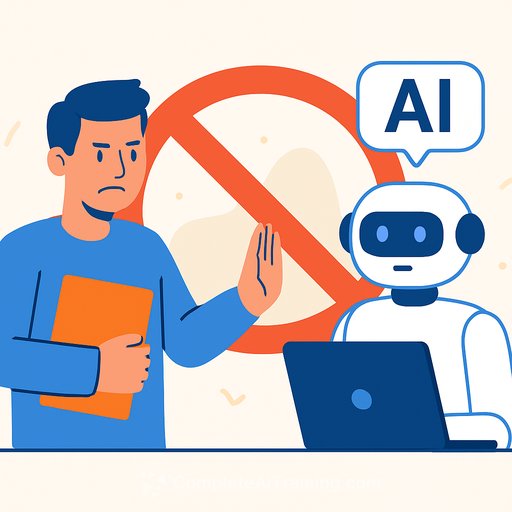
Roughly two-thirds of 1,200 U.S. job seekers have experienced an AI interview, according to an April Greenhouse survey. Nearly 4 in 10 candidates have withdrawn from a hiring process over one, a rejection rate that signals deep friction even as the labor market remains sluggish.
Art Hebbeler, a 65-year-old IT program director, answered a call expecting a routine pre-screening. Instead, an AI bot conducted the interview. "You've got to be kidding me," he said. He hung up early after the software repeated questions and interrupted him when he paused to breathe. "It was not ready for prime time."
Hebbeler has submitted more than 600 applications since January. He said ageism already works against him, and he expects AI interviews to become more common. "I would be very reluctant to take another AI interview, but unfortunately I think there's going to be more."
A growing backlash from candidates
While 70% of hiring managers in a separate Greenhouse report said AI helps them make faster hiring decisions with fewer resources, only 8% of candidates believe AI makes hiring fairer. The disconnect is fueling a quiet revolt. Some job seekers now blacklist companies that require AI interviews. Others post recordings of malfunctioning bot interviews on social media.
Aaron Holmes, a 41-year-old Seattle resident searching for live broadcasting roles, was initially curious about the technology. His optimism faded quickly. The AI interviewer had no natural cadence and could not answer his questions. "It left a really bad taste in my mouth," he said. Holmes now refuses AI interviews outright. "As much as I would like to get another job, it's going to be a hard no."
Accessibility and bias concerns
Tammy Wright, an instructional designer in Riverview, Florida, has a condition called nystagmus that causes involuntary eye movement. During an AI interview, the software repeatedly interrupted her and instructed her to look straight ahead. She could not complete her answers. "That was probably the lowest point in my search," Wright said. "It was just demoralizing that I couldn't be treated like a human being."
Some eye-tracking tools flag candidates who look off-screen, a feature meant to detect cheating. The American Civil Liberties Union has warned that predictive hiring tools relying on facial, audio, or physical interaction analysis "increase the risk that individuals will be automatically rejected or scored lower on the basis of disabilities, race, and other protected characteristics." A May working paper found evidence of racial disparities when many employers use the same third-party hiring algorithms, with Black and Asian candidates particularly likely to be adversely affected.
HireVue said in 2021 it stopped visual analysis of candidates. The company's CEO, Jeremy Friedman, previously said the company engages in "sensitive and important work around race, ability, and other protected statuses." Workday, which also faces complaints alleging bias in its AI hiring tools, has said it rigorously tests "to confirm our tools do not harm protected groups." Both companies have denied the claims against them.
Why recruiters keep using them
Career and leadership coach Phoebe Gavin said recruiters feel pressure to move faster. Some are evaluated on how quickly they fill roles, and hiring managers want to onboard someone to reduce their own workloads. The number of U.S. applicants per opening has doubled since 2022, according to LinkedIn. Two in three recruiters plan to increase their use of AI for pre-screening interviews this year.
"A lot of recruiters also feel very skeptical of these tools," Gavin said. She steers clients away from using AI to evaluate candidates but recommends disclosing it upfront if they do. "Companies are very, very bad at remembering they're being evaluated, too."
For HR teams navigating this tension, understanding where AI fits into the hiring process is becoming essential. Resources like AI for Human Resources can help professionals evaluate these tools critically rather than adopting them under speed-to-hire pressure alone.
Why this matters for HR professionals
The candidate backlash against AI interviews is not a fringe sentiment. When nearly 40% of applicants withdraw from a process, the cost is measurable: smaller talent pools, damaged employer brand, and potential legal exposure. HR leaders who continue using these tools should audit them for accessibility gaps and bias regularly. Disclosing AI use upfront, offering human alternatives, and training recruiters on the limitations of algorithmic screening can preserve efficiency without alienating qualified candidates. The companies that treat hiring as a two-way evaluation will have an edge in a market where talent is still hard to find.