
AI news ·
Justice department backs OpenAI in copyright fight as AI training threatens creative livelihoods
The Justice Department argues AI training on copyrighted material is fair use, even as OpenAI's News Corp licensing deal is worth over $250 million over five years.
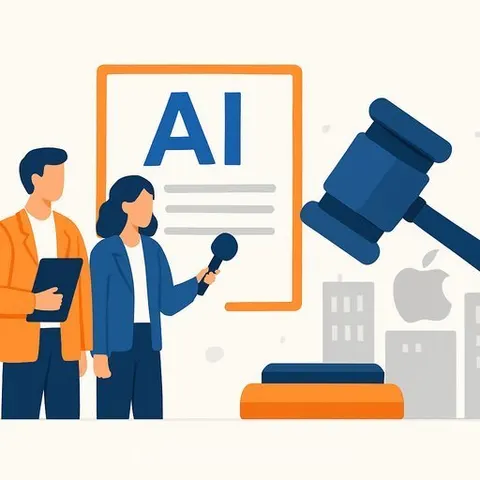
The Justice Department filed an amicus brief this week supporting OpenAI in its copyright fight with The New York Times, arguing that AI training on copyrighted material generally qualifies as fair use. Commerce Secretary Howard Lutnick carried the same message to the G20, urging governments to permit AI training on copyrighted works while still protecting creators. The filings push two convictions into uncomfortable proximity: the strategic necessity of beating China in AI, and the property rights of the writers, journalists, and artists whose work trains these systems.
Washington is right about the strategic stakes. America cannot surrender AI leadership to Beijing. But national security cannot become a phrase that dissolves property rights whenever somebody's work proves useful to a machine. The U.S. Copyright Office has already concluded that some uses of copyrighted works for generative-AI training may qualify as fair use and others may not, depending on the purpose of the use, how the material was obtained, what the model produces, and the effect on the market for the original work. The office warned that those market effects could occur on an "unprecedented scale."
The licensing precedent already exists
Calling all AI training theft would be too simple. But calling a work "training data" does not erase the human being who wrote, researched, edited, and published it. There is already a better model: pay for material that has value. OpenAI has licensing agreements with publishers including the Financial Times and News Corp. Its News Corp arrangement gives OpenAI access to current and archived material from The Wall Street Journal, Barron's, the New York Post, and other publications. Reuters reported that the deal could be worth more than $250 million over five years.
If professionally created content is valuable enough to support a quarter-billion-dollar licensing agreement, it is hard to argue that the same kind of human work suddenly has no compensable value when absorbed into an AI system. Anthropic agreed last year to pay $1.5 billion to settle a class action involving 500,000 pirated books, or about $3,000 per work. The company admitted no liability. The underlying case distinguished between training AI on lawfully obtained books and acquiring books from pirate libraries - piracy and fair use are not the same legal question.
The economic migration beyond copyright
Copyright is only the doorway into a larger problem. The International Labour Organization estimates that one in four workers worldwide holds a job with some degree of exposure to generative AI. The ILO expects most jobs to change rather than vanish. Its study of media and culture warns that AI is changing journalism, writing, music, film, and other creative work, affecting not only production but creative and decision-making processes.
For a writer, the concern is no longer simply whether AI copied a book. It is whether AI learned from that book, and millions like it, to build a machine capable of doing some of the work for which writers were once paid. The danger is not that human work disappears tomorrow. It is that more of the economic value produced by human skill gradually migrates to companies that own machines capable of reproducing portions of that skill. Professional journalism could become less economically sustainable, leaving fewer reporters to investigate government, war, courts, and corruption.
There is an irony here. AI depends on the accumulated knowledge and creativity of human beings. If the technology steadily weakens the economic incentives that produce the next generation of books, journalism, music, scholarship, and art, it could eventually impoverish the very intellectual environment from which it learns. The Constitution recognized this interest. Article I empowers Congress to secure authors exclusive rights for limited times "to promote the Progress of Science and useful Arts." Copyright has never been merely a favor to famous writers. Its larger purpose is to encourage people to keep creating.
A false choice between security and creators
America must remain first in AI. China would gladly dominate frontier models, industrial robotics, autonomous weapons, and the global AI ecosystem. We should not regulate American companies into strategic defeat. But we should reject the false choice. Preserving fair use, punishing piracy, and building licensing markets that compensate creators are not obstacles to keeping American AI ahead of Beijing. They are how national security and creative freedom can coexist, without treating America's intellectual inheritance as a free natural resource for the world's richest technology companies.
European regulators are already asking publishers whether Google's AI-generated search summaries reduce web traffic and advertising revenue, and whether publishers have meaningful control over how their material is used. The question of who captures the value as machines mediate more of what society reads, hears, and learns is no longer theoretical.
Why this matters for writers
The licensing deals between AI companies and major publishers prove that your work has measurable economic value to these systems. The $250 million News Corp deal and the $1.5 billion Anthropic settlement establish a market precedent: written content is not a free raw material. Writers should watch whether courts extend fair use to cover training on lawfully accessed copyrighted works, because that ruling will determine whether individual creators can negotiate payment or must rely on the thin protection of piracy law. The skills that make you employable - research, synthesis, clear prose, editorial judgment - are the same skills AI companies are extracting from your published work. Resources on AI for writers can help you understand which parts of your workflow are most exposed and where human judgment remains difficult to replicate. The strategic question for any working writer is not whether AI will change the profession. It is whether you will be compensated for the value your past work provides to the systems reshaping it.