
AI news ·
KAIST researchers develop AI that learns executable theories of the world from observation
KAIST's Neural Theorizer (NEO) learns causal rules from observation rather than predicting next frames. The model ranked in the top 0.7% of 23,918 ICML 2026 submissions.
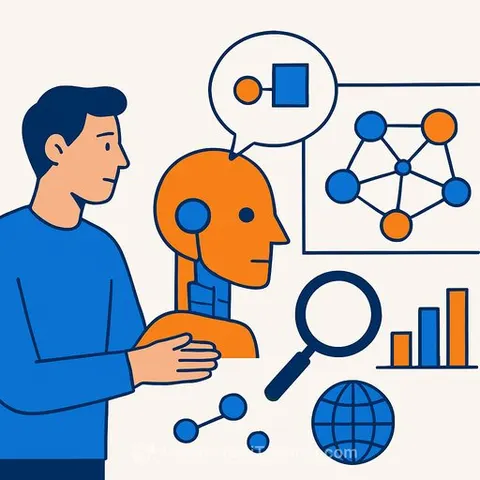
A KAIST research team has developed an AI model that learns to theorize how the world works from observation alone, rather than simply guessing the next frame. The system, called Neural Theorizer (NEO), earned an oral presentation at the International Conference on Machine Learning (ICML 2026) in Seoul, placing it among the top 0.7 percent of 23,918 submissions. It also won a Best Paper Award at the Compositional Learning Workshop.
World models underpin robot control, autonomous driving, generative AI, and autonomous agents. Most models built so far concentrate on predicting what scene might come next. Even when the prediction is accurate, the model does not necessarily understand the underlying rule that caused the change.
Learning-to-Theorize framework
The research group, led by Professor Sungjin Ahn from the School of Computing, turned to insights from developmental cognitive science. Long before children acquire language, they construct internal theories of how objects behave. The team's Learning-to-Theorize (L2T) method applies that principle: it provides no preset answers or rules. Given only a "before" and "after" observation, the AI must discover which rule produced the transformation.
From primitives to compositional generalization
NEO implements L2T by learning reusable primitives hidden in observed changes and composing them into executable programs. The model independently picks up basic operations such as rotation, leftward movement, or coloring. When it faces a combination it never encountered during training - "move down, then color, then rotate," for example - it recombines its primitives to explain the new situation. Conventional AI tends to memorize entangled patterns, and performance drops sharply on unfamiliar combinations. In tests, NEO outperformed existing approaches on compositional generalization, the ability to combine known rules to solve unseen problems.
"It points to a new direction beyond prediction-centric world models, what we call a 'World Theory Model.' We expect this to develop into a core technology across fields including intelligent robots, autonomous agents, and AI that supports scientific discovery," said Professor Ahn. The advance could strengthen AI for Science & Research, offering tools that reason about causes instead of merely projecting future states.
Why this matters for science and research professionals
For anyone building autonomous systems or analysing complex data, a world model that learns and recombines causal primitives from raw observation cuts the data and engineering needed to adapt to new situations. Rather than retraining on thousands of examples for each novel combination, NEO-like systems could transfer what they already know to unseen tasks. The method points toward AI that theorizes like a scientist - discovering rules from observation and applying them in new contexts, which could ultimately speed up hypothesis generation and experimental design.