
AI news ·
Kazakhstan and Belgium agree to establish mirror laboratory for AI and math at ALEM.AI center
Kazakhstan and Belgium signed agreements to create a mirror AI lab. It will target AI-driven metallurgical modeling with KU Leuven and math with Ghent University.
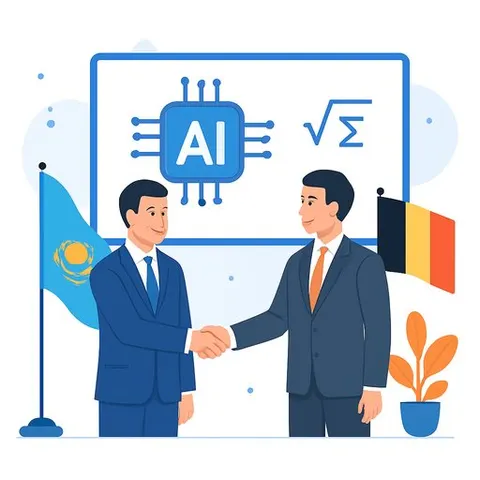
Kazakhstan and Belgium have signed a package of agreements to establish a mirror laboratory for artificial intelligence and mathematics at the new International Center for Artificial Intelligence ALEM.AI, creating a direct channel for Kazakhstani researchers to collaborate with European institutions. The deals, finalized during the Kazakh president's official visit to Brussels, include joint work on AI-driven metallurgical modeling and a formal mathematics partnership with Ghent University.
Critical raw materials and AI modeling
A memorandum signed between Serikbayev East Kazakhstan Technical University, KU Leuven, the SIM² KU Leuven Institute for Sustainable Metals and Minerals, and the Astana Hub autonomous cluster fund will focus on using AI to model metallurgical processes, analyze geological and production data, predict material properties, and optimize processing chains for critical raw materials. The work builds on the TiBrerium project under the Horizon Europe program, which already links European and Kazakhstani organizations in sustainable technologies.
The parties aim to shorten the path from laboratory development to industrial implementation. For Kazakhstan, the agreement signals a shift from raw material exports toward joint creation of knowledge, technologies, and high value-added products.
Mirror laboratory for mathematics and AI
In a separate memorandum, the Kazakh Ministry of Science and Higher Education and the Ministry of AI and Digital Development partnered with Ghent University to create a mirror laboratory in mathematics, AI, modeling, and engineering computations. The laboratory will be housed at the ALEM.AI center, run jointly by the Ghent Analysis & PDE Center and the Institute of Mathematics and Mathematical Modeling of Kazakhstan's Science Committee. Professor Michael Ruzhansky of Ghent University will serve as scientific coordinator, with Director General Mahmud Sadybekov leading the Kazakhstani side.
The distributed model gives Kazakhstani researchers direct access to Ghent's scientific expertise and methodology, enabling joint research teams and scalable cooperation aligned with academic and industrial needs. The agreement also covers academic exchanges under the Bolashak program, conferences, intensive schools, professional development programs, and joint startup projects.
The initiative reflects the growing importance of AI for Science & Research, where international partnerships accelerate discovery in foundational fields like mathematics and materials science.
Broader scientific cooperation and institutional support
The International Science and Technology Center (ISTC) will support the agreements by forming consortia, preparing joint projects, and expanding ties between Kazakhstani organizations and European research structures. ISTC's involvement aims to strengthen science diplomacy and attract international expertise in artificial intelligence, critical materials, engineering technologies, and scientific training.
During the visit, discussions also covered Kazakhstan's potential association with Horizon Europe, deep-tech development, engineering education, research commercialization, and broader international scientific cooperation. The new partnerships with KU Leuven, SIM², Ghent University, Astana Hub, and ISTC lay an institutional foundation for Kazakhstan's deeper integration into the European Research Area.
Why this matters for Science and Research professionals
For researchers and engineers in scientific fields, the mirror laboratory offers a concrete opportunity to join internationally distributed research teams without relocating permanently. The agreements provide access to European methodology, joint publications, and funding pathways through Horizon Europe and Bolashak exchanges. The focus on mathematical modeling and AI-driven materials science directly targets skills that are increasingly central to research careers in critical minerals, sustainable metallurgy, and computational engineering.