
AI news ·
Keeping the Human Touch Alive in Customer Experience Amid the Rise of AI
AI enhances speed and personalization in customer service, but overreliance risks losing the human touch. Customers still prefer real people for complex support.
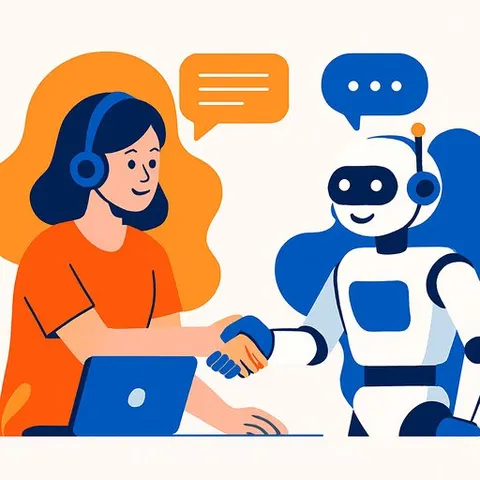
Will People Remain at the Center of Customer Experience in the Age of AI?
More than 40% of organizations now use AI-powered co-pilots for customer service, and 60% have implemented them for IT help desks, according to Nvidia. The use of AI is clearly growing as the technology becomes more human-like and capable. A recent survey for the 2024 Global State of CX Report ranked AI technologies for operations as one of the most impactful trends this year, second only to data and analytics.
AI delivers speed, scale, and personalization at levels previously unseen. Yet, as chatbots handle routine questions and algorithms predict customer needs, a key question arises: Are brands losing the human touch that makes customer experience truly memorable?
The Biggest Risk of Implementing AI
Concerns from customers, industry experts, and practitioners are mounting. Jane Hawkes, a CX thought leader, warned UK companies that replacing humans with chatbots risks losing customers. She pointed out that AI responses often lead to poorer outcomes, which could translate into lost revenue if companies follow trends without fully understanding customer preferences.
Leaders must ensure AI enhances, rather than replaces, the emotional intelligence and human connection customers value. Surveys consistently show that customers want to interact with real people. For example, over 90% of US consumers prefer human agents for customer interactions, according to a Kinstra survey. Another study by Five9 found 75% prefer talking to a human in person or by phone for support. Nearly half of consumers don’t trust information from AI-powered bots.
"AI has the power to reduce frustrations, but it's the human touch that truly makes a difference," says Niki Hall, CMO at Five9. By automating routine tasks with AI, human agents can focus on complex issues requiring critical thinking and empathy.
The Real Consequences of Prioritizing Technology Over Humanity
Jennifer Lee, COO at Intradiem, highlights the risks of focusing solely on automation. When companies neglect human connection, customers notice—and feel—the difference. This shift can lead to lower satisfaction, brand damage, and loss of loyalty and revenue.
How to Keep Humans at the Center of CX
Zendesk’s 2025 CX trends report emphasizes that human-centric AI is reshaping customer loyalty. But what does that mean in practice? Lianne Dehaye outlined the 5 Cs of customer expectations: consistency, convenience, competence, customization, and continuity. These basics should guide AI use in customer experience.
AI can transform customer engagement when aligned with these principles. However, processing large volumes of customer data also brings risks like ethical issues, operational inefficiencies, and reputational damage. The goal isn’t to solve every problem with AI, but to solve the right problems. Organizations should ask, "What should AI do?" rather than "What can AI do?"
Customer experience expert Shep Hyken, summarizing the book AI Mindshift: Unleash the Power of AI, Avoid the Pitfalls and Keep the Human Experience, stresses the importance of a smooth handoff from AI to humans. Customers want quick answers, and AI chatbots can provide immediate first responses. But the key is enabling a seamless transition to a human agent when needed. This approach shortens what Hyken calls the Time to Happiness—the speed at which a frustrated customer becomes satisfied.
Experts agree that choosing the right tasks to automate is critical. Automate manual, repetitive work and use AI for real-time insights and sentiment analysis to know when to escalate to a human agent. Jennifer Lee advises measuring AI success not just by efficiency but also by quality, using CX metrics like customer satisfaction (CSAT) and net promoter score (NPS).
Some may think avoiding AI is the way to keep humans relevant in customer service. However, that risks falling behind. The value of AI depends on the people applying it effectively. As one expert puts it, adopting AI is about making smarter decisions faster by combining human insight with machine intelligence to create opportunities that were impossible before.
For customer support and management professionals looking to build skills in AI and customer experience, exploring targeted training can be valuable. Resources such as Complete AI Training’s courses by job role offer practical knowledge to blend AI with human-centered CX effectively.