
AI news ·
King’s Scientists Secure £400,000 to Advance Safe and Cooperative Human-AI Collaboration in Maritime and Urban Systems
King’s College London researchers secured £400,000 to improve safe human-AI collaboration in urban and maritime settings. Their work addresses skill retention and AI cooperation challenges.
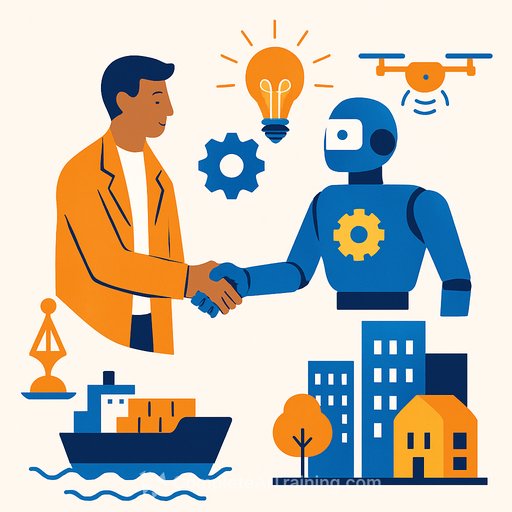
King’s Computer Scientists Secure Government Funding to Advance Safe Human-AI Collaboration
Two researchers from King’s College London’s Department of Informatics have been awarded up to £400,000 by the AI Security Institute, supported by the UK’s Department for Science, Innovation and Technology. Their work focuses on addressing practical challenges of integrating AI into urban environments and maritime operations, aiming to ensure a smooth and safe transition to AI-powered systems.
Ensuring Skill Retention in AI-Enabled Maritime Operations
Dr Caitlin Bentley, Senior Lecturer in AI Education, is examining how AI is changing maritime roles. Autonomous systems now manage tasks once performed by human operators, such as navigating seas or inspecting offshore wind infrastructure. Operators are shifting towards supervising multiple AI agents rather than direct control. However, because these tasks are mission-critical, humans must remain in the loop to intervene during emergencies.
Dr Bentley highlights a key concern: overreliance on AI could erode operators’ skills, introducing safety risks. To address this, she is collaborating with maritime autonomous trainer Seabot and Frontier Robotics to develop simulated challenges and tailored educational pathways. These tools aim to keep experienced operators’ skills sharp while lowering barriers for new entrants to become AI-ready.
This approach may shorten traditionally lengthy maritime qualifications and open opportunities for remote operators, potentially increasing diversity in a male-dominated sector. According to Dr Bentley, “AI-enabled maritime vehicles are now deployed more widely, offering new ways to maintain offshore windfarms and conduct sustainable sea surveys. Yet skilled operators remain essential to detect anomalies, especially when AI systems might miss nearby objects.”
Addressing Skills Shortage and Future Challenges
Dr Martim Brandão, a Lecturer in Robotics and Autonomous Systems involved in the project, emphasizes a dual benefit: “Providing an educational on-ramp helps tackle the current skills shortage and preserves the expertise of existing workers.” He adds that ongoing preparation for AI-related challenges is crucial for protecting critical energy and shipping infrastructure as technology evolves.
Evaluating Cooperation Among Generative AI Systems
Dr Yali Du, Senior Lecturer in Artificial Intelligence, investigates how generative AI models interact in real-world applications like driverless cars, smart traffic management, and automated production. As these AI agents increasingly operate side-by-side, understanding whether their interactions are cooperative or competitive is essential for safety.
Dr Du explains, “Smart city concepts depend on AI agents working together, but without clear insights into their interaction patterns, deployment risks increase.” She provides an example involving two driverless cars approaching the same intersection: if both agents are overly cooperative, traffic stalls; if both act selfishly, collisions occur.
Her research aims to gather data on such interaction outcomes to establish safety benchmarks. Future work will also explore how AI agents respond to human behaviors, ensuring harmonious collaboration between humans and AI.
These projects highlight the importance of preparing both people and AI systems for integrated operation in complex environments. For professionals interested in enhancing their AI expertise, exploring specialized educational resources can be valuable. Visit Complete AI Training's latest AI courses for practical learning pathways.