
AI news ·
Koo pitches Korea as AI manufacturing hub to US business leaders
South Korea's finance minister pitched the country to US business leaders Wednesday, pledging market reforms and AI cooperation. He reiterated targets of 3% growth, top-four exporter status, and $50,000 per capita income, citing a $350 billion bilateral investment framework.
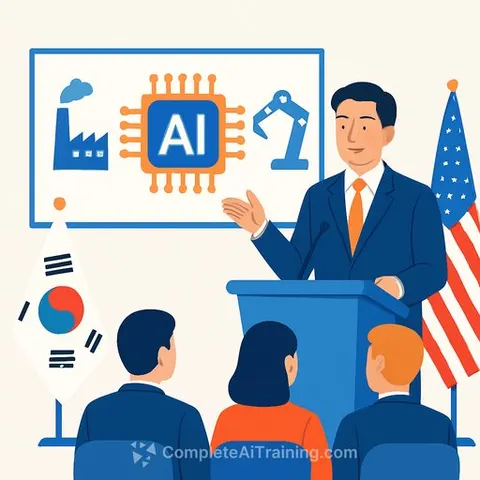
South Korea's finance minister pitched the country as an investment destination for US business leaders in Seoul Wednesday, emphasizing artificial intelligence cooperation and pledging continued financial-market reforms. Deputy Prime Minister and Finance Minister Koo Yun-cheol spoke at an American Chamber of Commerce in Korea luncheon attended by about 150 government officials and executives from Korean and international companies.
The event followed a financial sector policy report AmCham submitted to the government earlier this year and marked the latest round of policy dialogue between Seoul and foreign businesses operating in Korea. "Any company that invests in Korea is a Korean company," Koo said, thanking AmCham members for their investment and job creation over the past seven decades.
Growth targets and market reforms
Koo reiterated the government's "3-4-5 vision" of raising Korea's potential growth rate to 3 percent, becoming one of the world's four largest exporters, and lifting per capita income to $50,000. Semiconductors, AI data centers, and physical AI sit at the center of that strategy.
He also highlighted ongoing capital and foreign exchange market reforms aimed at improving market accessibility for global investors. On foreign exchange, Koo reiterated plans announced in July to internationalize the won, following the transition to 24-hour foreign exchange trading on July 6 and ahead of the launch of an offshore won settlement system in January.
The government had "actively reflected" recommendations in AmCham's financial hub report, Koo said, including a request to raise reporting thresholds for foreign currency borrowing by foreign bank branches and limits on corporate cash pooling from $50 million to at least $100 million. The changes were largely outlined in the government's July roadmap.
AI cooperation and manufacturing
Koo placed particular emphasis on artificial intelligence, arguing that Korea could gain an edge as competition shifts toward physical AI by combining US strengths in software with Korea's manufacturing base. "The US is the world's leader in AI-related software and LLMs (large language models)," Koo said. "For that technology to be applied in the real world, it needs to be combined with manufacturing capabilities."
He cited shipbuilding, steel, and petrochemicals as industries where such cooperation could generate greater value, describing the US as Korea's most important partner in the AI transition. For professionals tracking how AI moves from software into industrial applications, the intersection of US models and Korean manufacturing is where the practical returns may land - a focus area in AI for Finance discussions around capital allocation and productivity gains.
AmCham Chairman and CEO James Kim said the group heard a consistent message during meetings with US officials in Washington last month that the next phase of Korea-US economic ties should focus on "tangible investment in strategic sectors, deeper technology cooperation and greater regulatory alignment," particularly in the digital economy.
The discussion also turned to implementation of the $350 billion Korea-US strategic investment framework. Koo said talks with Washington were ongoing, with energy emerging as a major area of interest alongside shipbuilding, biotechnology, critical minerals, and artificial intelligence. Seoul is working with Washington to identify projects that could benefit both countries, while urging AmCham members to propose commercially viable projects for bilateral cooperation.
Why this matters for finance professionals
For finance executives, the concrete signals are the regulatory changes. The raised thresholds for foreign currency borrowing and corporate cash pooling directly affect how treasury teams structure cross-border operations in Korea. The won's internationalization timeline - 24-hour trading already live, offshore settlement launching in January - creates practical implications for currency exposure management and hedging strategies.
The government's commitment to treat foreign investors equally, paired with its push for US-Korea AI collaboration, suggests sectors like industrial AI and manufacturing technology could see increased cross-border capital flows. Executives weighing Korea as a gateway to Asian markets may find the reform agenda worth monitoring, particularly as Seoul works to align its regulatory framework with US expectations - a dynamic explored in AI for Executives & Strategy as companies assess where to deploy capital in an AI-driven economy.