
AI news ·
Korea allows copyright for AI-assisted music but faces honesty dilemma
South Korea now allows AI-assisted music to earn copyright royalties, but only if humans lead the creative process. KOMCA admits that distinguishing AI from human work is nearly impossible and relies on creators' honesty.
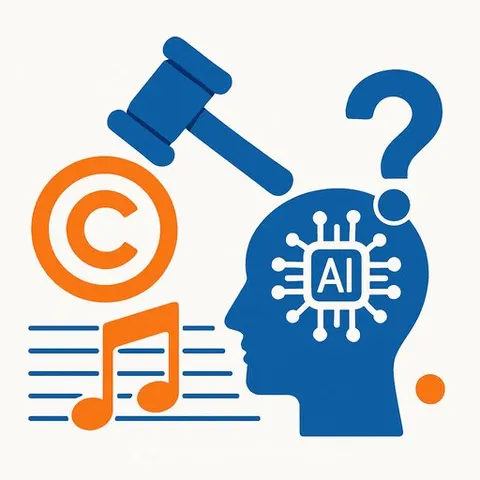
Music created with the help of artificial intelligence can now be registered with the Korea Music Copyright Association (KOMCA) and generate copyright royalties - but only if humans played a substantive and leading role in writing, composing, or arranging the work. The new reporting and registration standards took effect August 3, but KOMCA and copyright experts acknowledge that objectively distinguishing what was created by AI from what was created by humans remains difficult. In practice, the system will rely heavily on creators' own disclosures and honesty.
Songs generated entirely by AI based only on prompts are excluded from registration. Works can be registered when AI was used as a supporting tool, as long as a human substantially led the creative process. However, registration with KOMCA does not itself determine whether a work qualifies for copyright protection under law or establish who ultimately owns the rights - it is a procedure for the trust management of economic copyrights and the collection and distribution of royalties.
How the registration process works
Creators must start with disclosures. They must declare which parts of the work involved AI, what tools were used, how they were used, and what creative work they personally performed. KOMCA initially reviews applications based on those declarations and may request supporting materials such as project files and sheet music for technical verification or internal review.
KOMCA also plans to establish grounds for suspending royalty payments or recovering improperly paid royalties when false declarations are identified. If false declarations cannot be detected, a creator could delegate most of the work to AI while claiming they led the creative process and still receive royalties. Improper payments for AI-generated material could undermine confidence in the entire royalty distribution system.
Where to draw the line between human and AI
Some cases are straightforward. A person may write the lyrics and melody and use AI only to supplement the accompaniment. At the other extreme, a user simply enters prompts and AI generates an entire song. But the distinction becomes "far less clear when a person modifies an AI-generated melody or selects and combines several AI-generated outputs," according to KOMCA and the Digital Intellectual Property Institute.
Project files and edit histories can only document processes that were actually recorded. AI music detection programs can identify works generated entirely by AI to some extent, but once a person modifies AI-generated "a user, it becomes difficult to determine the original AI-generated portion or the extent of human changes from the finished song alone. If creators do not disclose their use of AI, reconstructing the entire production process after the fact is virtually impossible."
Verification becomes substantially more difficult as AI tools become embedded in standard software. When AI features such as Adobe Photoshop's Generative Fill become standard tools within existing programs, determining from the finished product whether AI was used or tracing the extent of human contribution becomes extremely difficult.
Legal limits and industry-wide implications
South Korea's AI Basic Act, which took effect in January, requires providers of generative AI products to indicate that outputs were AI-generated. It does not require ordinary users to disclose the scope of AI use or their own contributions. Even when a work carries an AI disclosure, consumers may have no way of knowing precisely which parts were created or how extensively AI was used.
The same problem extends beyond music into film, broadcasting, advertising, games, webtoons, and web novels. A writer might create a fictional universe and its characters, then use AI to generate dialogue for a specific scene and then revise the output. The finished work alone makes it difficult to separate AI contributions from human ones.
"Only the creator can know exactly where and how extensively AI was used," a copyright expert said. "If someone uses to create a draft using ChatGPT or Claude and then revises it, determine where and how AI was used ultimately depends on the honesty of the creator who used it."
Why this matters for creators
Songwriters, music producers, and other creative professionals now have a way to register AI-assisted works and collect royalties - but only if they are truthful about their role. The rules explicitly tie royalty eligibility to honest disclosure of AI use, and KOMCA intends to audit false claims. For creators, this means the burden of proof falls on end users to document their production process. AI Learning Path for Vocal Artists & Songwriters training can help you understand the tools and building the right documentation practices.
The larger implication for all creatives: as AI tools become standard features in everyday software, the ability to prove your own creative contribution - and justify your claim to royalties - will increasingly depend on the records you keep now. AI for Creatives resources cover the documentation strategies that protect your work. Without honest disclosure, the entire royalty system risks collapse. Whether you write songs, novels, scripts, or ad copy: start keeping track of how you used AI, and be prepared to show your work.