
AI news ·
Korea invests 20 billion won to develop physics-based AI for scientific discovery
South Korea launched a 20 billion won, seven-year program to build AI models that embed physics and math, funding four university teams to make AI explainable and stable under unfamiliar conditions.
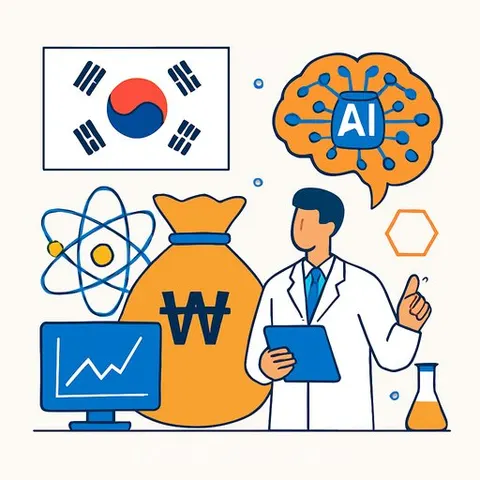
South Korea's Ministry of Science and ICT (MSIT) has launched a 20 billion won research program to build AI systems that use physics and mathematics alongside data to interpret scientific phenomena. The seven-year project, announced on the 24th, selected four research teams to develop AI models that can explain their reasoning and maintain accuracy in conditions they've never encountered before.
Most current AI systems learn by finding patterns in massive datasets, then predicting outcomes based on those patterns. In scientific and engineering fields, this approach has a weakness: the AI can't explain why it produces a specific result, and its accuracy drops when conditions shift beyond its training data.
The project aims to fix that by embedding physical laws and mathematical principles directly into AI models. It also funds work on new AI architectures that go beyond the limits of existing models.
Two research tracks, four teams
The project splits into two areas: physics- and mathematics-based AI interpretation models, and next-generation AI architecture research. Two teams were selected in each area. All four will receive GPU computing infrastructure, and the data and models they produce will be shared through an open platform.
Professor Hau Seok's team at KAIST will develop a "mathematics- and physics-based causal AI model" that infers the causal structure and governing equations embedded in data. The goal is a model that stays stable even when conditions or environments change.
Professor Yoo Jae-seok's team at the Daegu Gyeongbuk Institute of Science and Technology (DGIST) will build an "AI dynamicist" that identifies which physical laws dominate across different phenomena, allowing the AI to choose its own interpretation strategy. This approach should produce consistent results that align with physical laws regardless of changing conditions, reducing the cost and time spent on redesign and validation.
In the architecture track, Professor Oh Min-hwan's team at Seoul National University will mathematically analyze the structural limits of current AI models, whose computational load grows sharply as context length increases. They aim to develop new architectures and training methods that process long contexts efficiently.
Professor Yoon Cheol-hee's team at KAIST will work on the principles behind how generative AI models improve through learning. Their goal is a next-generation AI development methodology covering architecture design, training, and reliability verification, so models can operate stably with relatively small amounts of data and computing power.
For researchers working in science and engineering, the immediate question is whether these models will hold up outside the lab. The project's focus on stable performance under changing conditions addresses a real pain point: current AI tools often fail when applied to new experimental setups or unseen data ranges.
Why this matters for science and research professionals
Yoon Kyung-sook, Director-General for Basic Research Policy at MSIT, framed the project's value in practical terms: "If we secure AI models based on the laws of physics and mathematics, the rigor and accuracy of scientific research will be enhanced, providing practical benefits not only to research sites but also to industrial sectors such as semiconductors and batteries."
The open platform component matters for working researchers. When the project's models and datasets become available, they may offer alternatives to black-box AI tools that can't explain their outputs. For researchers who need to publish reproducible results, an AI model that can show its reasoning based on physical laws may be worth the wait. Those who want to prepare in the meantime can explore AI for Science & Research resources or follow a structured AI Learning Path for Research Scientists to build the skills needed to evaluate and apply these models as they emerge.