
AI news ·
Lawyers face a choice on who controls AI in legal work as insurers move first
An AI-powered law firm has obtained liability insurance covering its AI systems, a move that could let insurers set human oversight standards for legal AI. The firm warns lawyers must define their own "human in control" rules before insurers impose them.
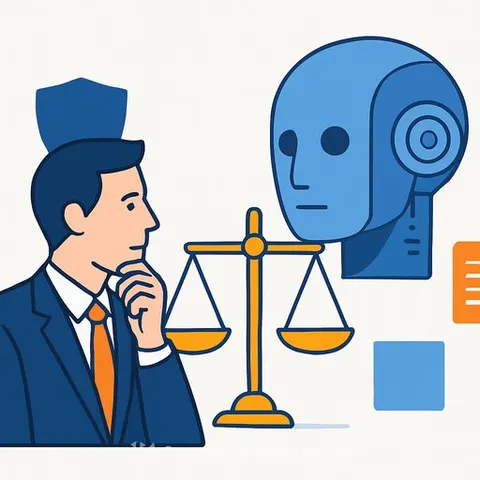
The legal profession still has time to decide how much control humans should exercise over AI in law. But that window is closing, and insurers may be the ones to make the call if lawyers don't.
That's the argument in a recent essay from Crosby, the AI-powered law firm, which announced plans to obtain liability insurance covering decisions made by its AI systems. The firm's announcement opens a broader question: who gets to define what "human in control" means as AI takes on more legal work?
The distinction matters. "A human can be in the loop without exercising much control," the essay notes. "A lawyer who clicks 'approve' on an AI-generated decision may technically provide human oversight while exercising little judgment."
Insurance as a de facto regulator
If lawyers don't set their own standards for AI use, insurers may do it for them. Crosby's insurer will make judgments about testing, supervision, documentation, escalation, and when a human must intervene - all to determine what risks are covered.
This is already happening in other industries. In February, voice-AI company ElevenLabs secured what was billed as the first insurance policy for agents, with coverage conditioned on certification against a private standard that subjects agents to more than 5,000 adversarial tests, logging of activity, real-time human intervention, and assigned human accountability for what agents do.
Insurance has a long history of filling gaps where public regulation is incomplete. Fire insurers created Underwriters Laboratories, whose safety mark still governs everyday products. Auto insurers founded the Insurance Institute for Highway Safety, whose crash tests established vehicle safety standards beyond anything federal law required.
Underwriting requirements can establish standards organizations must follow to obtain insurance. Those requirements can influence industry norms, expectations about reasonable conduct, and even legal standards.
Why the legal profession can't stay vague
The legal profession has struggled for more than a century to articulate a coherent definition of what constitutes the practice of law. That ambiguity has served the profession well, allowing lawyers to protect a broad territory from competition without saying precisely where that territory begins and ends.
AI makes maintaining that boundary harder. It allows legal work to be divided between humans and machines at a scale and level of autonomy the profession hasn't confronted before.
The "human in control" framework asks more of lawyers than the familiar "human in the loop" approach. It means human lawyers decide what to delegate to AI, under what conditions, subject to what safeguards, and with what accountability. It requires choices about where machines should augment human judgment and where human responsibility should remain.
Those decisions are already being made by technology companies through product design, by clients through purchasing decisions, and by insurers through underwriting requirements and exclusions. Each decision may look narrow on its own, but collectively they establish norms and boundaries of acceptable conduct. Practices become expectations; expectations become standards; standards can eventually influence the law.
The profession can make a choice by not making one. But the people with the least influence over this process may be those most affected by a failure to choose. "Clients and consumers whose rights, liberty, property, families, and businesses depend on legal decisions are unlikely to be present when an insurer and an AI-powered law firm negotiate the conditions under which an autonomous system may operate."
Why this matters for legal and insurance professionals
For lawyers, the practical takeaway is to start defining your own standards for AI oversight before an insurer does it for you. That means documenting when human review is required, what that review must include, and who bears responsibility when an AI system makes a mistake.
For insurance professionals, the opportunity is to shape those standards. Underwriting requirements are becoming a form of private regulation for AI - the same way AI for Insurance standards have evolved in other industries. Insurers who engage with AI-powered legal services now will help set the norms that others will eventually be measured against.
For both groups, the question is no longer whether AI will be used in legal work. It's who decides the conditions. AI for Legal professionals who act now - by setting internal policies, negotiating coverage terms, and documenting human oversight - will have more say than those who wait for standards to be imposed on them.