
AI news ·
Lawyers must choose between using AI to understand or to replace thinking
AI-generated "legal slop" risks producing documents that look perfect but contain critical errors. The key split is between lawyers who use AI to train their understanding and those who use it to replace thinking.
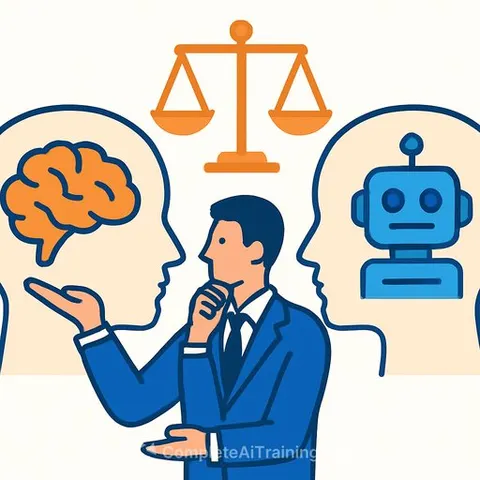
AI has made producing legal work nearly frictionless, but it remains on lawyers to understand and stand behind that work. The temptation to let the machine handle comprehension as well as drafting is the defining challenge of the profession right now.
Whether it is a resume, a contract, or a regulatory overview, the phenomenon known as "AI slop" has a recognizable texture: grammatically perfect, structurally turgid, and intellectually orphaned. The person who produced it may not understand or agree with every sentence. Sometimes they haven't even read it.
Consider the associate who circulates a clean diligence summary that mischaracterizes a change-of-control clause. Or the in-house lawyer who forwards an AI-generated regulatory overview that omits the one jurisdiction that matters. The finished product creates negative value.
The split between production and understanding
Generative AI has collapsed the friction involved in producing words. It can draft the email, summarize the cases, and generate the contract without a person deciding what any of it should say. That is a genuine technological miracle.
In a world where knowledge work is expressed in words, one could be fooled into thinking that the rocks are also doing the work. But work is called "knowledge work" for a reason. As one observer put it, "production isn't understanding." For most of history, drafting a complex document took long enough that a lawyer had to engage with its substance. Writing and revising created natural speed bumps: questions arose, assumptions were tested, and mistakes became visible.
For tasks that are ministerial, AI will be a boon to productivity. As long as the output passes a spot check, it works fine. But for the work that matters, product without understanding isn't productivity. Standing behind the thing is the actual point.
Reverse distillation: training your own model
Cognitive surrender occurs when a person uses AI not to extend thought but to replace it. The tool produces a plausible answer and the human accepts it without making the underlying knowledge their own. That is the intellectual equivalent of potato chips.
The alternative is what lawyers can practice: using AI to become someone capable of producing the asnswer, not just to get the answer. When foundation model companies complain about open-source developers "distilling" their models, they mean a training technique where a smaller "student" model learns by asking questions of larger "teacher" model. That is exactly how humans should be using AI, say advocates of the approach. The distinction is simple: whether you are using AI to produce an answer, or to become someone capable of producing the answer. The former creates output. The latter creates capability.
"The easy path is to ask AI for the answer and forward it back," one practitioner explained. "The junior lawyer can't answer basic questions about the assignment: What doctrines are embedded here? What assumptions are being made? AI can surface all of this and teach it to the junior lawyer, but only if the lawyer asks it to. This isn't 'prompt engineering.' This is professional identity formation."
Why this matters for legal professionals
The coming era of legal work will split along a single fault line. On one side will be those who use AI to train their own mental models - becoming faster, sharper, and more capable with every interaction. On the other will be those who use it to replace thinking - producing more while understanding less. At first the difference will be subtle. Then it will be decisive.
Legal education is beginning to grapple with this reality, with some law schools combining device-free foundational courses with integrated AI instruction. Firms face the same imperative. The old apprenticeship model relied on the fact that producing legal work took time, and learning happened along the way. AI breaks that linkage, but it also creates a new opportunity: time freed from production can be reinvested in understanding. The firms that can measure comprehension, not just completion, and identify cognitive surrender early - work that looks polished but collapses under scrutiny - will retain the capability that makes legal advice valuable in the first place.
AI for legal training programs that emphasize explanation over output and AI learning pathways for paralegals are examples of the kind of explicit development required to avoid the slop and keep true professional judgment intact.