
AI news ·
Legacy systems and fragmented data slow adoption of artificial intelligence and digital twins in ports
A study of 50,000 port connections shows AI and digital twins face high costs and data barriers in shipping. Success requires workforce training and integrated systems.
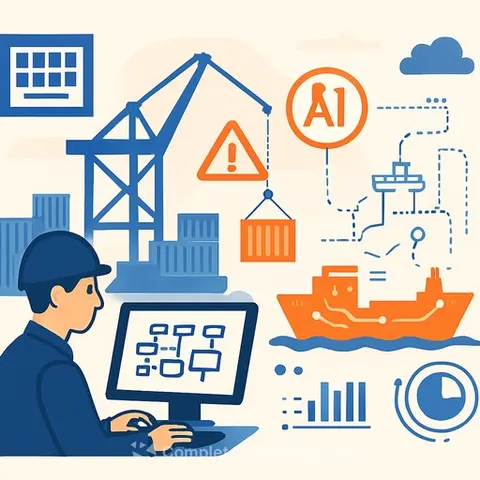
Artificial intelligence and digital twins are moving from pilot projects towards operational use at ports, but high implementation costs, fragmented data and workforce concerns remain significant barriers, according to new research published in Maritime Economics & Logistics. The collection of nine academic papers examines how ports and shipping companies are using AI, automation and machine learning to manage cargo flows, infrastructure and commercial risk.
The Rotterdam findings
Research based on interviews at the Port of Rotterdam found that AI could improve cargo coordination, operating accuracy and decision-making across port communities. The principal obstacles, however, were not the algorithms. High costs, poor compatibility with existing systems and worries about the effect on jobs continued to slow deployment.
The researchers said ports would need stronger data governance and workforce training if AI projects were to progress beyond limited applications. The value of the technology depends on whether information can be shared reliably between port authorities, terminals, shipping lines and service providers. For operations managers facing these skill gaps, the AI Learning Path for Operations Managers offers structured guidance on process optimisation and supply chain AI.
Digital twin on the Po River
Another study developed a digital twin for inland shipping on Italy's Po River. The system combined live sensor readings, historical information and machine learning to predict water levels and improve the coordination of vessel movements and port calls. The project showed how digital twins could help ports and inland operators move from reactive scheduling towards earlier warnings and more proactive planning, particularly where operating conditions change rapidly.
Patent activity points to monitoring and optimisation
A separate analysis of maritime technology patents identified vessel-condition monitoring, wireless communications, operational optimisation and container inspection as the principal areas attracting development activity. Researchers also examined almost 50,000 container-port connections recorded between 2016 and 2024. Their work indicated that disruption during the pandemic permanently altered some relationships between major gateways, providing another potential use for data-led network analysis.
Connecting systems, not just installing tools
The studies suggest that the competitive value of port technology will increasingly come from connecting systems rather than installing individual tools. Ports already generate large quantities of operational data, but much of it remains divided between organisations or trapped in incompatible platforms. Digitalisation can only improve berth planning, cargo visibility and port-call performance if that information is accessible and trusted.
The central challenge is therefore shifting from proving that AI and digital twins work to embedding them inside complex port communities without weakening human oversight or creating new operational dependencies.
Why this matters for operations
For operations managers, the research highlights a practical reality: AI and digital twins can deliver real gains in coordination and planning, but only if the underlying data infrastructure and workforce skills are in place. The bottleneck is no longer the technology itself - it is the willingness to invest in integration and retraining, and to design systems that support rather than replace human decision-making.