
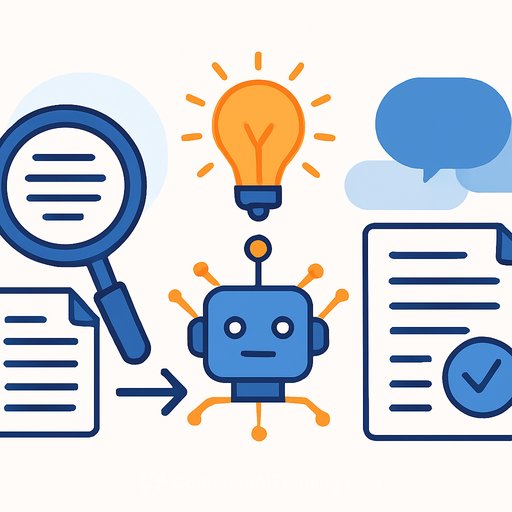
Legal search has shifted from matching keywords to reading intent. People can now describe a legal problem in ordinary words - "my employer cut my hours after I complained to HR" - without naming a body of law or picking a practice area first. The system must figure out whether that is retaliation, discrimination, a wage and hour issue, or something else entirely.
That distinction matters because keyword search only works when the person already knows the right term. In legal discovery, that is often not the case. Intent-based search, sometimes called semantic search for legal services, reads the relationship between a situation and the law that might govern it. It can identify the same need across many different sentences that share no vocabulary.
One question can carry many needs
A single query often contains multiple legal issues. Someone who writes "I was fired, my employer still owes me commission and I signed a noncompete" is describing termination, unpaid compensation and a restrictive covenant in one sentence. Each issue involves different timelines and legal implications. Forcing that query into a single keyword or practice area risks losing two of the three critical issues.
Conversational search handles this through what Google's documentation describes as a "query fan-out" technique. AI Overviews and AI Mode may issue several related searches across subtopics and data sources to build a response, splitting a question into subtopics, searching them at once, then bringing the results together.
That approach fits legal discovery well. One plain language question carries several jobs at once: identifying the legal issue, the practice area, the jurisdiction, the urgency, the relevant information and the type of professional expertise needed. These factors influence one another directly, so the AI must evaluate them simultaneously to provide accurate guidance.
Follow-up questions beat instant classification
First questions are often ambiguous. "My business partner took money from the company" could be a breach of fiduciary duty, a contract problem, fraud, conversion, the start of a business divorce or an authorized draw. No lawyer reading that sentence knows yet which one it is.
Sometimes the useful next move is a question rather than a classification. A conversational system can ask where it happened, when, who the parties are, what has already been done, and whether a deadline or filed case is in play. That transparency makes the AI's reasoning visible - it shows the user what the system is considering and why.
Reading intent is only the beginning. The system must transform a raw description into a structured legal context using a framework: query to context to intent to classification to legal pathway. At the classification stage, it identifies the possible legal issue, the related practice area, jurisdiction considerations, urgency factors, relevant information and the type of professional expertise required. The resulting legal pathway organizes the user's next steps, connecting their situation to legal categories, actionable resources and the right professional expertise.
Broad practice areas are not enough
Matching someone to a general employment lawyer may miss the point. A person involved in a dispute over executive compensation may need someone who specifically handles employee-side compensation matters. Commercial litigation is too wide a category for someone facing a shareholder dispute within a closely held company. The most effective legal discovery systems must identify these granular needs rather than relying on high-level labels.
Legal meaning depends on more context than ordinary search carries. Location, facts and timing can send the same question to very different answers. So can practice area, client type, professional qualifications and the court or regulator involved. For legal professionals, this changes how discovery works: AI for legal search now requires systems that read ordinary language, hold context and turn a description into a pathway - without requiring the user to know legal terminology first. For support roles, the shift is equally direct: AI learning paths for paralegals now center on interpreting client narratives and organizing case-relevant information, not just retrieving documents.
Why this matters for legal professionals
Semrush's 2026 AI Visibility Index, drawn from more than 126 million U.S. AI search prompts, describes ChatGPT, Google AI Mode, Gemini and AI Overviews as reshaping discovery through conversations. Legal taxonomy, context and professional expertise still provide the underlying structure, but the interface has changed. People can now start from their own situation without knowing the right legal terminology or practice area first.
The next stage of AI legal search depends less on people getting better at keywords and more on systems that read ordinary language, hold context and turn a description into a pathway. That pathway names what the issue may involve, which legal categories apply, what other facts matter and what professional expertise may be needed. A system can read a situation correctly and still point someone the wrong way - interpretation is only the first step. The harder question in law is whether the information, recommendation or legal pathway that follows can be trusted.