
AI news ·
Microsoft, Uber and Hyatt reduce customer support jobs as AI adoption increases
Analysts predict generative AI will eliminate 50% of customer support roles by 2030. Microsoft already cut 10,000 jobs to save $750 million.
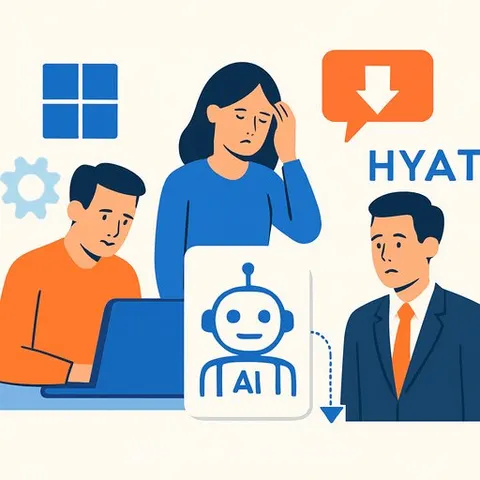
Microsoft, Uber, Hyatt, and the Commonwealth Bank of Australia have cut thousands of customer support jobs in recent years as they deploy generative AI to handle user interactions. Analysts now predict that automation could eliminate roughly half of all customer support roles by 2030, with outsourcing hubs in India and the Philippines bearing the heaviest losses.
Generative AI reshapes support work
For decades, companies automated basic support with scripted chatbots. Large language models changed that. These systems now handle complex conversations, resolve multi-step problems, and mimic human dialogue without pre-written responses. As companies integrate generative AI, the technology behind AI for Customer Support has advanced far beyond simple keyword matching.
Projected job losses hit outsourcing hubs
Kate Leggett, an analyst at Forrester, said automation will deliver a serious blow to the labor market. "By 2030, about 50% of all positions in the field of customer support will be under threat of reduction," she said. Countries that built large call center industries - primarily India and the Philippines - face the most disruption. The shift is a matter of economic expediency, not an ethical choice, according to Ryan Teeples, chief tax strategy officer at 1-800Accountant. "The focus on AI is not a temporary solution, but a strategic shift aimed at radical savings," he said.
How four companies are cutting costs with AI
Microsoft reduced its technical support workforce from 50,000 to 40,000 in recent years, a move that includes both full-time staff and contractors. The company expects annual savings of $750 million. The Commonwealth Bank of Australia, the largest bank in the southern hemisphere, cut hundreds of chat support staff and replaced them with AI, saving tens of millions of dollars per year. Uber cut 10% of its support staff while rolling out a chatbot for user communication. Hyatt eliminated 30% of its support staff last year, attributing the cuts to automated systems built on AI.
Why this matters for customer support professionals
The job reductions are not a one-time adjustment. They signal a permanent restructuring of how companies provide support. Workers who develop skills in AI-assisted support workflows will be harder to replace. Training that focuses on overseeing, training, and improving AI tools - rather than performing repetitive tasks - can help professionals stay relevant. AI Learning Path for User Support Specialists offers targeted training for those looking to build exactly these capabilities.