
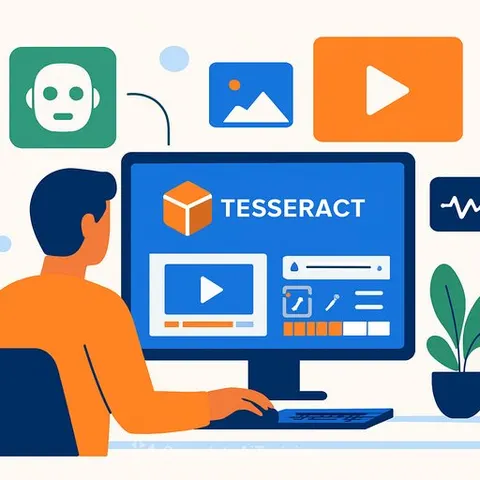
Mirage released Tesseract on September 22, a video creative suite that lets AI agents build and edit professional video without a traditional editing interface. The tool gives agents direct access to a native video engine, removing the need for separate motion, audio, and editing applications - and it runs on a free local engine with no Captions account or credits required.
"Think of Tesseract as Premiere and After Effects, rebuilt for agents," said Gaurav Misra, co-founder and CEO of Mirage. "We're giving creators the power to make professional video simply by describing what they want, right where they already work, without paying for another editing subscription or learning a complicated new tool."
How agents work with video concepts directly
Instead of clicking through a timeline or constructing video through HTML or React, agents using Tesseract interact with core video concepts: layers, compositions, keyframes, masks, adjustment layers, timing, and sound. This native approach produces motion design that feels crafted for video rather than adapted from a web page. Agents can turn user-supplied footage, images, brand assets, and audio into finished projects, from product-launch films and social ads to animated typography, diagrams, and footage with graphic overlays.
A single workflow without switching tools
Users provide creative direction and any assets. The agent builds a project and refines it through feedback, all within one environment. The project remains editable throughout - users can ask their agent to rework an entire sequence or make a specific change, such as adjusting a keyframe, changing a title's timing, or rebalancing the music. Agents can save the project, export the finished video, and reopen it for future revisions.
The entire workflow, including previewing, rendering, and export, runs on Tesseract's free local engine. Users do not need a Captions account, API key, or Captions credits. They remain responsible for their chosen agent's subscription or model-usage costs. Installation instructions are available on GitHub, and Tesseract requires a compatible agent environment that can access local files and execute local tools.
Why this matters for creatives and writers
Tesseract changes the barrier to video production for writers and creative professionals who already direct work through AI agents. Instead of learning a complex editing suite or paying for another subscription, a writer can describe a video sequence - complete with timing, typography, and sound cues - and have an agent execute it. This keeps the creative direction in the writer's hands while offloading the mechanical work of video assembly. For those building skills in this area, AI Video Creation Courses can help bridge the gap between traditional storytelling and agent-driven production.
Mirage, headquartered in New York City, builds AI-native creative tools including Captions and Tesseract. The company is recognized by the Forbes AI 50 and backed by General Catalyst, Index Ventures, Kleiner Perkins, Andreessen Horowitz, Sequoia Capital, HubSpot Ventures, and Adobe Ventures. More details are available at mirage.app/tesseract.