
AI news ·
MIT and Lakes Region Community College launch AI math pilot for New Hampshire high schoolers
MIT and Lakes Region Community College ran a four-week AI pilot this summer for 16 New Hampshire high schoolers, one of only two such rural-focused programs in the U.S.
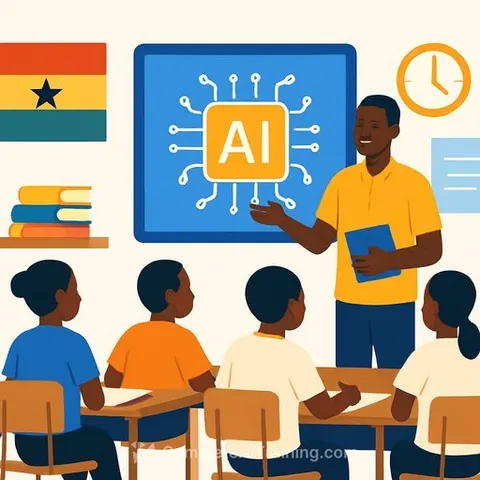
Lakes Region Community College and MIT launched a four-week pilot course this summer that brought 16 New Hampshire high school students together to learn the math behind AI and apply it to real problems. The program, called "Gateway to AI," is one of only two such pilots in the country - the other runs in Wyoming - and targets students from rural communities with limited access to advanced STEM instruction.
The course was created by MIT professors led by Arup K. Chakraborty, with input from teachers at both pilot sites. Chakraborty said he has long seen a gap between what students in rural America get exposed to and what their urban peers have access to.
"For a long time, I've believed that many of our young high school students in rural America do not get the same opportunities to see and take advantage of the future possibilities, compared to people in urban areas," said Chakraborty. "We want to change that. It doesn't matter what these young people plan to pursue in their lives - if they work in manufacturing, at a CVS, or in agriculture they will encounter AI. It will likely be present in every aspect of their lives. Also, the need to think deeply and analytically, and ask the right questions, will become even more important than before."
Students came from towns across the state, including Center Sandwich, Concord, Gilford, Gilmanton, Laconia, Meredith, Moultonborough, Nottingham and Salem. The program prioritized teens from communities with limited science, technology, engineering and mathematics enrichment.
Learning the math behind AI
The first two weeks focused on linear algebra - the mathematical foundation of AI systems - taught in the context of how AI tools actually use it. Students also covered statistics before moving into hands-on projects in the second half of the course.
"I definitely didn't expect the program to be so hands-on," said Asa Buchakjian-Tweedy from Spaulding High School in Rochester. "I knew we would be learning about linear algebra which is the basis of AI models. I thought we'd be mostly sticking to that, but we've also been learning the statistics behind it and how to implement it."
The course was taught by Inter-Lakes High School teacher Susan Foss-Finch, who traveled to MIT to help shape the curriculum. MIT student Jadyn Grant served as the on-site teaching assistant. Later this month, MIT will fund a day-long campus visit so participants can tour research labs and meet MIT students.
Applying AI to real problems
Students put their new skills to work on three projects. On a farm visit, they photographed crops and used an AI tool developed by Ground Truth Analytics to identify plant types and growth stages. A health care project used an MIT-developed tool that analyzes mammogram data to generate breast-cancer risk scores; students had to decide how to schedule follow-up screenings given the results and other constraints.
A third project, for New Hampshire-based St. Mary's Bank, used Allogy's Capillary platform to build an AI chatbot that helps members navigate financial goals like saving for college or starting a business. Students explored how changing factors like inflation could influence financial decisions.
"I hope students walk away with a better understanding of what AI is as well as its capabilities and limitations," said Foss-Finch. "AI is a great tool that will help our society move forward. It's not something we should fear, but something we should learn to use and use well."
For educators, the course model offers a template for teaching AI literacy that goes beyond tool usage. Teachers interested in building similar skills can explore an AI Learning Path for Teachers or browse AI for Education resources.
Why this matters for educators
The pilot reflects a growing expectation that AI literacy belongs in high school curricula - not as an elective for the already-advantaged, but as a baseline skill. The course's structure, pairing math fundamentals with applied projects, gives educators a working example of how to teach AI without relying on expensive equipment or urban tech ecosystems. MIT plans to expand the program to additional communities, which could create more opportunities for rural schools to offer similar instruction.
Patrick Cate, president of LRCC, framed the program in terms of access. "We were proud to be part of this," he said. "Students from across New Hampshire had the opportunity to learn about topics that are not typically covered in high school. That's a direct reflection of what LRCC and all of New Hampshire's community colleges exist to do: connect our communities to opportunities they might not otherwise have."
Student Sydney Conkling from Inter-Lakes High School in Meredith offered a simpler summary. "It's a really good way to spend your summer and broaden your horizons."