
AI news ·
MIT engineers introduce adaptive robotic therapy system trained by physical therapists
MIT engineers built a dual-arm robot that uses generative AI to learn physical therapy from human practitioners. A clinical study in Munich is underway to train therapist-specific models.
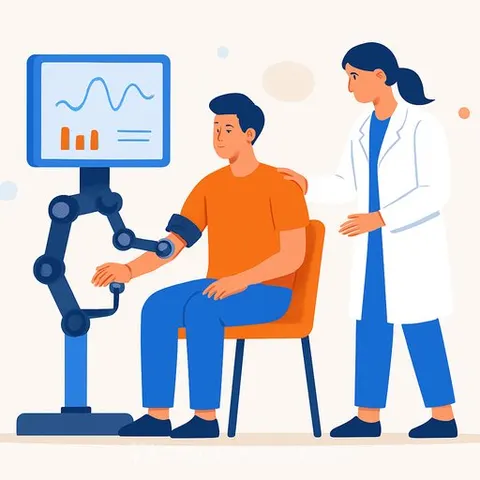
MIT mechanical engineers have built a dual-arm robotic system that uses generative AI to learn physical therapy techniques directly from human practitioners. The platform addresses a critical gap in rehabilitation care by extending the reach of licensed therapists to more patients without replacing their expertise.
How the system learns
The robot relies on force-feedback technology combined with transformer-based diffusion models to adjust its movements during treatment sessions. Instead of following rigid programmed paths, the machine responds to touch, resistance, and patient effort. Researchers trained the model through telemanipulation experiments where healthy participants performed arm lifts and reaching tasks while deliberately changing their exertion levels. This created a dataset teaching the robot how to match assistance to a person's active participation.
"While most generative AI models in robotics focus on motion, ours is among the first to learn physical interaction, i.e., how to respond to touch, force, and resistance," said Noah Geiger, a former visiting student at MIT now working at Robert Bosch GmbH. The architecture shares design principles with Generative AI and LLM systems, but applies those patterns to dynamic contact rather than text or image generation.
Clinical validation underway
The project has moved beyond laboratory testing into a live clinical study at an outpatient rehabilitation center in Munich, Germany. Physical and occupational therapists wear force-sensing gloves while cameras record their hands treating patients. Engineers are using this footage to train separate AI models that capture each therapist's unique handling style. Johannes Lachner, who led the research as an MIT-Novo Nordisk Artificial Intelligence Postdoctoral Fellow before joining Purdue University, said the early trials already proved the concept works.
"Initial robotic experiments have already demonstrated the feasibility of this approach," Lachner said. "The next phase of the project aims to develop therapist-specific models and evaluate them in a long-term clinical study with the same patients who previously received manual therapy." The work expands on earlier biomechanics research directed by MIT professor Neville Hogan, pushing past flat-plane reaching exercises into functional, multi-directional movements.
Why this matters for healthcare professionals
Rehabilitation clinics face mounting pressure from rising patient volumes and chronic shortages of licensed physical therapists. A system that adapts to individual therapist methods allows facilities to scale personalized care protocols across shifts and locations. Clinicians can use the robot to maintain consistent exercise intensity during repetitive sessions, freeing staff to focus on complex assessments and patient education. As these platforms integrate further into standard AI for Healthcare workflows, they offer a practical way to extend therapeutic reach while preserving the human judgment that guides recovery.