
AI news ·
MIT study finds habitual AI use reduces cognitive engagement and weakens independent thinking
A four-month MIT study of 54 writers found ChatGPT weakens brain connectivity and reduces writing quality. Researchers call this mental decline cognitive debt.
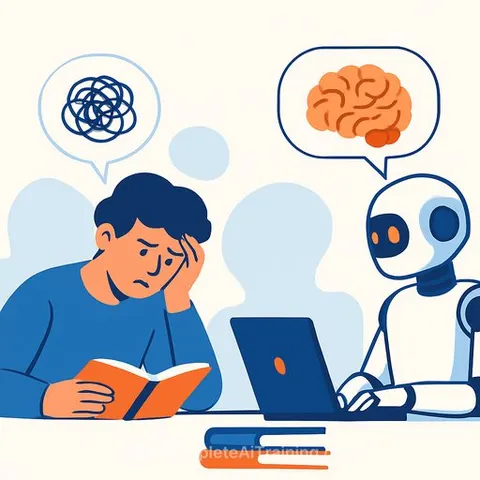
In June 2025, MIT Media Lab researchers published preliminary results from a four-month study, *Your Brain on ChatGPT*, that tracked the brain activity of 54 writers using EEG. Participants who relied on ChatGPT produced more formulaic, lower-quality writing and showed significantly weaker neural connectivity, especially in brain networks tied to creativity and working memory. The findings raise urgent questions for anyone who creates for a living.
What the MIT Study Found
Researchers divided participants into three groups: one wrote without digital assistance, one used Google Search, and one used ChatGPT. The unaided writers showed the strongest and most widely distributed neural activity, engaging circuits linked to creativity, language, memory and critical thinking. The ChatGPT group's frontal theta networks - essential for working memory and executive function - fired least of all.
Lead researcher Dr Nataliya Kosmyna described their brains as entering a "power-saving mode." The researchers called this slow erosion cognitive debt. When writers switched from AI-assisted to unaided work later in the experiment, they struggled to regain the same level of mental engagement. Their essays were not only weaker but also less memorable: they had trouble recalling what they had written just minutes after finishing.
Beyond Writing
A 2025 study in *Societies* surveyed 666 people and found a significant negative correlation between frequent AI use and critical thinking. The author attributed the drop to "cognitive offloading" - the brain does less when the tool does more. Another review in *Frontiers in Psychology* reported that students who over-relied on AI during creative tasks experienced cognitive fixation and lower creative confidence. Early-stage brainstorming with AI replaced the messy, exploratory thinking that builds creative skills.
The pattern holds across contexts: AI lifts productivity while quietly reducing the mental effort that develops long-term ability. The work gets done. The person doing it simply engages with it less.
From Essays to Everyday Decisions
The same dynamic appears far beyond the classroom. Asking a chatbot which sofa to buy rather than developing personal taste. Letting algorithms navigate every trip instead of building a mental map. Relying on machine suggestions for the next sentence rather than finding your own rhythm. Individually small, collectively these delegations may reshape how people think.
Even professional sport has shifted. Clubs increasingly use algorithms to scout players, curbing the need for deep in-person observation. Data catches trends but misses temperament, character, and how someone performs under real pressure. A 2025 randomised controlled experiment on arXiv found that AI assistance reduced persistence on difficult tasks and left participants performing worse once the technology was removed. Researchers labelled the effect "gradual disempowerment." Users grew better at getting answers but less capable of finding them independently.
The Case for Optimism
The evidence isn't entirely one-sided. Some studies suggest AI can improve creative confidence, generate fresh ideas and enhance collaboration when used to support rather than replace human thinking - a balance explored in many AI for Creatives resources. The MIT study itself found that participants who completed independent work first and then used AI only to revise achieved the strongest outcomes. They showed better brain connectivity, produced higher-quality essays and reported greater satisfaction.
In other words, AI helped most when it came after the thinking, not before it.
Why this matters for creatives
The research points to a clear guardrail: do the thinking first. Front-load the messy, unstructured phase of a project - brainstorming, problem-framing, making ugly early drafts - before turning to AI for refinement. This isn't about rejecting the tool. It's about protecting the mental muscles that make you a creative professional in the first place. As the MIT findings show, when AI serves as a revision partner rather than an idea generator, your brain stays more engaged and your work gets stronger. The risk isn't using AI. It's outsourcing the part of the process that actually builds your skill.