
AI news ·
Most billion-dollar AI startups lack published scientific papers
More than half of AI firms valued at over $1 billion lack peer-reviewed papers, a Stanford analysis shows. This prevents independent verification of their claims.
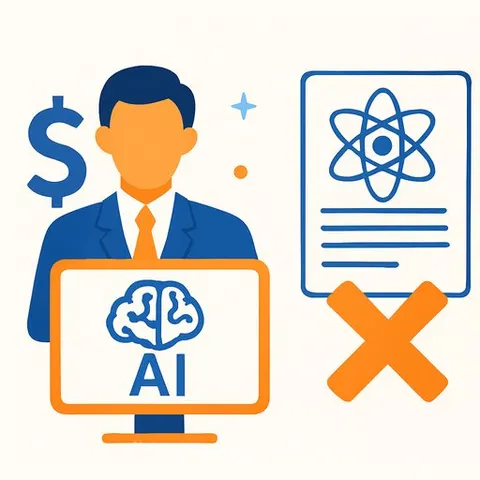
More than half of AI's private companies valued at over $1 billion have never published a qualifying scientific paper or preprint, according to a new analysis by Stanford professor John Ioannidis. The finding, reported in Science Magazine, intensifies questions about whether the technology these firms produce can be independently evaluated or reproduced.
Ioannidis is no stranger to questioning high-profile startups. In 2015, he was among the first to publicly highlight the absence of peer-reviewed studies from Theranos, the blood-testing company that later collapsed amid fraud charges. Now he turns that scrutiny to the AI industry.
The study examined AI unicorns-private companies valued at more than $1 billion. It found that even among those that do publish, their role is often minor, contributing to papers rather than leading them. Celina T. Zhao reported the findings for Science Magazine, noting the disconnect between bold commercial claims and the near-total absence from the scientific literature.
Why AI companies stopped sharing what they know
The retreat from open publishing is not accidental. As one commenter on Hacker News put it, "publishing is most valuable to people who have no other way to get the attention of smart strangers." Once a company can hire almost anyone it wants, the main effect of publishing is to tell competitors what worked. That dynamic has played out before. When dyes became commercially valuable in the 19th century, interesting chemistry moved from open journals into company labs and stopped coming out. AI appears to be following the same path, shifting from an open science into a guarded industry. The trend away from open publication raises concerns for fields that rely on AI for Science & Research, where reproducibility is paramount.
The business model of many AI companies depends heavily on training models with publicly available data, including academic papers. Critics call this pattern selfish: companies consume the open research of others while contributing little of their own. Public papers give an advantage to competitors who may give nothing back, and rivals can build under the radar when research is freely available. That fear, commenters said, is why companies are so cautious about publishing.
Peer review, reproducibility and the line between science and hype
Science relies on peer review and reproducibility. When AI companies shift from publishing open research to guarding trade secrets in black boxes, some observers argue it marks a transition from genuine scientific discovery to commercial hype. Without published, reviewable work, outsiders have no way to independently verify the claims these startups make to investors, regulators and the public. The Theranos comparison is pointed: that company's lack of published, peer-reviewed evidence was an early warning sign that something was wrong.
Could licensing rules force openness?
The preprint has sparked debate about whether legal tools could push companies to share their findings. Some commenters floated the idea of a copyleft requirement for research-a kind of viral knowledge license that would compel anyone who builds on a published paper to publish their own related work. The concept drew skepticism. A copyleft paper does not compel someone who makes a product based on it to publish more papers. Copyright law does not deal with abstract ideas passing through people's minds. The GPL, the most famous viral software license, has never had its definition of "derivative work" fully tested in court. Supporters countered that if a person can agree not to talk about something under a nondisclosure agreement, or not to work in a field under a non-compete clause, then a contract requiring publication of future work in a given area should be possible. Others pointed out that any such agreement would need tightly defined boundaries to survive legal challenge. The reach of "related research" is inherently fuzzy, and overly broad terms would likely be struck down. An existing license, the Reciprocal Public License, already attempts something similar for software, though it has seen limited adoption.
A different view from an early-career researcher
Not everyone sees the retreat from openness as inevitable. One undergraduate physics student described publishing a paper on recursive self-improvement mapped to Epoch AI data, then reaching out to a UK professor working on similar research. The two compared overlapping results and different methods. The student's takeaway: for young people getting into any field, research is a great way to meet new people and build connections that would otherwise be out of reach. For early-career scientists, the networking benefits of publishing remain strong, a principle that aligns with the goals of many AI Research Courses.
Why this matters for science and research professionals
For researchers who depend on AI tools or evaluate AI-driven discoveries, the lack of published evidence is more than an academic concern. It means that many widely used models and claimed breakthroughs cannot be independently validated. The Ioannidis analysis serves as a reminder to scrutinize AI claims that lack peer-reviewed backing, and to advocate for transparency in the systems that increasingly shape scientific work. The shift toward secrecy may be rational for individual companies, but it exacts a collective cost on the integrity of the research ecosystem.