
AI news ·
Most white-collar jobs face full AI automation within 18 months, survey finds
60% of 933 U.S. business leaders expect full white-collar automation within 12-18 months, yet 42% say AI is already reducing their workforce. The gap between prediction and practice suggests leaders confuse technological possibility with operational readiness.
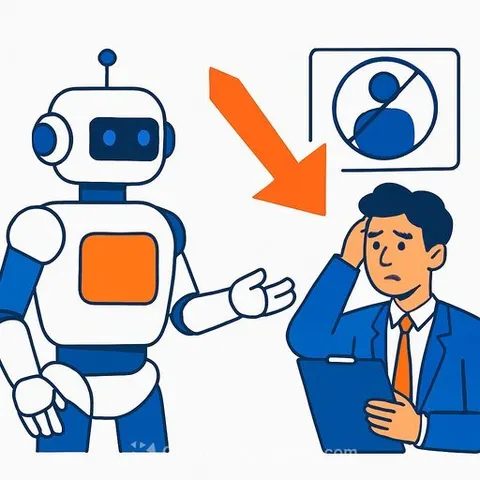
A new survey of 933 U.S. business leaders found that 60% believe most white-collar jobs will be fully automated by AI within 12 to 18 months. The figure should alarm office workers, but it should also give executives pause, as it suggests leaders are mistaking technological possibility for operational readiness.
The survey, conducted by ResumeTemplates, follows Microsoft AI CEO Mustafa Suleyman's prediction that AI would achieve human-level performance on most professional tasks within that same window. When ResumeTemplates asked executives whether they agreed with that forecast, many did.
Julia Toothacre, Chief Career Strategist at ResuemeTemplates, told Dr. Gleb Tsipursky on the Wise Decision Maker Show that the 60% figure is partly aspirational. Senior leaders often hear sweeping AI predictions and turn them into assumed business targets, even when their organizations lack the systems, training, workflows, and governance to execute on that timetable.
Real displacement, but not overnight
The survey's deeper numbers paint a more layered picture. Forty-two percent of business leaders say AI is already reducing their workforce, and 24% say they actively eliminating roles because AI can perform the work. Another 18% report consolidating roles or cutting backfills, while 10% say they are slowing hiring in certain areas. But that doesn't amount to white-collar work disappearing overnight.
McKinsey's 2025 global survey found that 88% of respondents report regular AI use in at least one business function, while nearly two-thirds say their organizations haven't scaled AI across the enterprise. That combination - active experimentation with limited deployment - explains why leaders can believe in rapid disruption while moving slowly in practice. AI tools spread quickly; changing jobs, incentives, data flows, quality controls, and decision rights doesn't.
Anthropic's Economic Index points the same direction. A57% of Claude-related occupational tasks are classified as human collaboration, and 43% as automation. The dataset shows no evidence of entire jobs being automated. The impact shows up task by task before it hits job titles.
The difference between tasks and jobs
That distinction changes the management challenge. Firing people because a tool can perform 30% of their tasks may destroy institutional knowledge while leaving the remaining 70% unmanaged. Keeping everyone while ignoring AI leaves the organization bloated and vulnerable to competitors. The smarter path: ask employees to identify repetitive tasks, build AI agents for those tasks, and shift their remaining work toward judgment, coordination, customer understanding, and exception handling.
The pressure on workers is real. LinkedIn reports that the pace at which members add new skills has increased 140% since 2022. ResumeTemplates found that 83% of leaders say early-career employees should prioritize AI skills, with 71% saying the same for mid-career professionals and 67% for late-career workers.
The survey also found many leaders now suggest some white-collar workers consider trades or blue-collar careers. That advice reflects a broader revaluation of work that combines technical skill, physical presence, and judgment that's hard to automate. The Bureau of Labor Statistics projects several fastest growing occupations through 2034 in health care, energy, data science, cybersecurity, and industrial maintenance.
The takeaway isn't about leaving corporate work entirely. It's about career resilience through choosing work where AI increases leverage rather than erasing a worker's core contribution.
Redesign before replacement
The near-term path ahead is more likely to follows a redesign before replacement. AI can handle a meaningful chunk of many white-collar tasks today, but managers still need people to handle exceptions, coordinate with customers, and make judgment calls. The most dangerous executive mistake, according to the experts quoted in the survey analysis, would be to announce an AI target without an adoption system.
What works instead: choose the right use cases, train employees, redesign workflows, assign responsible oversight, and track metrics that distinguish of theater from productivity. Toothacre's advice to leaders is practical - get feedback from employees at every step. Employees know which reports exist only because nobody fixed the process. They know which approvals protect quality and which add delay. They know where AI can save material and where an automated answer would create real risk.
Why this matters for executives and strategy
The 60% figure matters because it shows many leaders have already made the mental leap to replacing human work with AI. But a carefully executed rollout that targets repetitive tasks and frees teams to handle harder problems will produce better outcomes than a hard forced headcount reduction. The businesses that win will be the ones that learn to treat AI as a performance system, not a headcount weapon. The rest will know how to use AI - but not what to do in the organization once the agents arrive.