
AI news ·
Nearly half of managers feel unprepared to lead AI-native hires, survey finds
45% of employers are recruiting AI-native talent, but only 13% of managers feel equipped to lead them, per an Indeed and YouGov survey. The readiness gap is forcing firms to rethink performance reviews and supervisor training, with 88% of AI-hiring companies offering manager training versus 8% of...
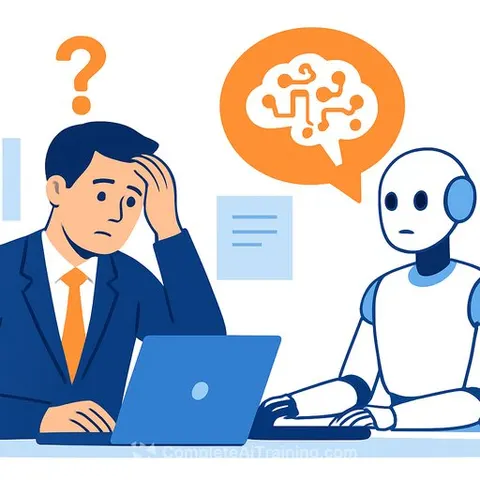
Nearly half of employers are actively recruiting workers who default to AI for most of their work, but only 13% of managers feel strongly equipped to lead them, according to a new survey from Indeed and YouGov. The gap between hiring and management readiness is forcing companies to rethink how they evaluate performance, train supervisors, and structure work itself.
The survey found that 45% of employers are recruiting AI-native talent - employees who use AI to design, execute, and scale their workflows. Yet nearly half of managers who already lead these workers say their direct reports outskill them. Companies that hire AI-native talent are far more likely to offer AI-related manager training than those that don't, at 88% compared with 8%, suggesting preparation follows the hiring decision rather than leading it.
Why managers feel behind
Stephan Meier, the James P. Gorman Professor of Business at Columbia Business School, said leading people who use AI well requires different skills than using AI itself. He compared it to managing someone who is better at Excel - a manager doesn't need to match that skill level to oversee the work.
"You don't need to be an Excel wizard to manage people who use Excel," Meier said. "I think the same is true with AI."
Wen Wen, an associate professor at the McCombs School of Business at the University of Texas at Austin, pointed to a structural reason managers lag behind their teams. Employees use AI for discrete tasks like writing, coding, or analyzing data. Managers must coordinate an entire workflow that blends human work and AI output across a team.
"The team members are doing all those discrete tasks, and then the managers need to think about how to organize this kind of AI-enabled workflow," Wen said. "This is probably one of the reasons managers are behind their teams, because they're managing a much more complex and uncertain problem."
The evaluation problem
Wen's research, including a recent Harvard Business Review study on AI-enabled workflows, found that when employees rely heavily on AI, managers lose visibility into what those employees actually contribute. Polished work that is almost entirely AI-generated can look identical to work someone did largely on their own.
To separate the two, Wen said, a manager would need a clear sense of what AI alone can produce in a given role, then work backward to determine what the person added. Most organizations don't have that benchmark, leaving managers to guess at how much of an employee's output reflects real skill. That complicates decisions about promotions, team structure, and how work gets assigned.
Training trails behind hiring
Kyle M.K., senior talent strategy advisor at Indeed, traced managers' lack of readiness to how companies have historically chosen them. "We typically hire managers who are operationally gifted," he said. "Now with AI, especially with an AI-native team, they've got to focus a little bit more on the output, not necessarily the process itself."
The survey backs up the training gap: 62% of employers already offer AI-related manager training, yet 39% of managers say they still need more. That mismatch has pushed many managers toward self-directed experimentation instead of structured skill-building.
"Any progress that's been made today has been due to a DIY culture that's come out of the lack of training," Kyle M.K. said. "Folks are just experimenting on their own."
For organizations working through these challenges, AI for Management training can help supervisors build the coordination and evaluation skills the survey shows they lack. HR teams facing these readiness gaps may also find relevant guidance in AI for Human Resources resources.
What comes next for managers
Wen's research points to three priorities for managers: change how you evaluate people, get ahead of the coordination problems that come from a team producing more work with AI, and make sure junior employees still get the hands-on experience they'll need to become good managers themselves. What matters most, she said, is redesigning the work itself.
"What they need to really focus on is how they can redesign the workflow and the job responsibilities," Wen said.
Meier expects the manager's role to keep shifting rather than disappear, as employees direct their own AI agents and managers increasingly become managers of managers. "Everybody in your team is also now kind of a manager, because they manage agents," he said. "Coordinating those processes becomes probably harder, but it's the same kind of techniques we used to manage before. Maybe it's just a faster pace."
Kyle M.K. said that shift points toward a different kind of leadership skill, one he calls becoming an "architect of trust": a manager who prioritizes transparency and relational skills over technical mastery of the tools themselves. "You really strengthen those relational skills, not just the technical skills we've been used to, and be more of a people leader," he said.
Why this matters for managers
The World Economic Forum's Future of Jobs Report 2025 found that employers expect 39% of workers' core skills to change by 2030, with leadership and talent management among the skills rising in importance. For managers, the practical takeaway is that technical proficiency with AI tools matters less than the ability to coordinate AI-enabled workflows, evaluate output fairly, and build trust with teams whose skills may outpace your own. Companies that don't adapt their management approach face a real risk, Kyle M.K. said.
"It would most likely be a bad thing if you continue to operate with the same playbook you might have been using for the last 30 years," he said.