
AI news ·
Nebraska K-12 schools explore AI tools for grading and lesson planning while setting boundaries
More than 80% of Nebraska teachers used AI last school year, but districts are still defining where a teacher's judgment starts and ends. Syracuse's superintendent urges staff to use AI for time-saving tasks while keeping final grading and teaching decisions human.
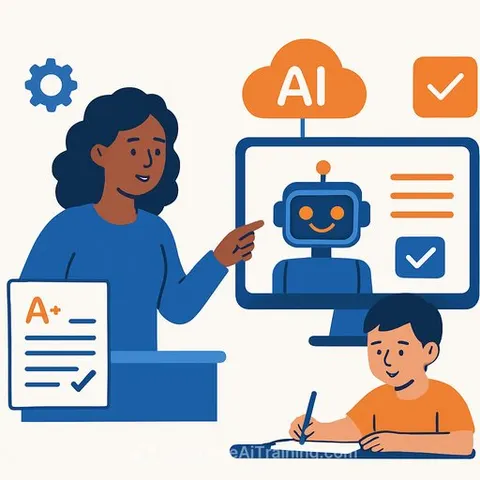
K-12 schools in Nebraska are moving beyond simple AI cheating bans and exploring how the technology can help teachers with grading, lesson planning, and classroom materials - though district policies and training are still catching up.
More than 80% of teachers reported using AI during the 2023-24 school year, according to a Center for Democracy & Technology survey, and more than half of teenagers say they've used AI to find information or get help with schoolwork, per the Pew Research Center. Nebraska districts show signs of those same trends.
David Kraus, superintendent of the Syracuse-Dunbar-Avoca consolidated district, encourages staff to use AI for time-consuming tasks like drafting difficult emails, but he draws a clear line. "There's a difference between it doing your job and saving you time," Kraus said.
Teachers in his district also use AI to adjust lessons for students at different learning levels, including those struggling in reading and math, and to create songs that help students memorize vocabulary words.
Districts define teacher use after summer AI festival
Kraus attended America's Youth AI Festival in Boston this summer, where he heard from experts and other school leaders while his son Landry helped draft a student bill on AI in education with 97 other students from across the country. The experience pushed Kraus to update his district's policy to spell out acceptable uses.
"Can teachers use it to grade papers? Can it be used to create lesson plans? Where does the spectrum start and end with teacher use?" Kraus asked. "Our policy doesn't even talk about learning. Also, it doesn't talk about the literacy piece of how we're going to educate our kids as well."
Eileen Heller, an education consultant at Educational Service Unit #3 in the Omaha metro, tells teachers to focus on what students should do in a lesson, then figure out what AI can assist with. "You want them doing the analysis. You want them doing the summary creation, whereas you can lift up the AI to assist them in things," Heller said. That might mean brainstorming topics or asking for feedback on essay structure.
Heller also pointed to AI use in adjusting lesson plans for multilingual students and those with individualized education plans.
The transition recalls how schools handled the arrival of calculators, said Adam Carlson, assistant director of professional learning at ESU 3. "In education, we're working on keeping teachers and students focused on that foundational learning that they need to do so that they can take those next steps," he said.
Students see uneven grading practices among teachers
Landry Kraus, now a freshman at Syracuse-Dunbar-Avoca, saw different approaches to AI grading while using a tool called StudySync. Some teachers accepted AI-assigned grades and reduced students' scores, while a different teacher read each essay herself before assigning marks. "She likes AI, but she knows how to use it," he said. "She didn't go off grade. She always read through the essay and graded it herself."
The student bill drafted in Boston included a section recommending that teachers clearly state their AI policies in syllabi and review lesson materials to vet AI-generated content for lessons. The bill is not law, but will be sent to more than 10,000 school leaders across the country.
Teachers outside Nebraska already report time savings. Sixth-grade teacher Megan Wissing said she used a feedback tool called Class Companion after testing it against her own grading habits. "If I have 100 students and it takes me seven minutes to grade each essay with feedback, that's 700 minutes. I'm saving time with the AI," she said.
Still, leaders stress the teacher's role doesn't disappear. Wissing, who plans to go tech-free in her classroom this year, said the AI tool can suggest "Hey, you need to add more details about this," but it can't deliver the core lesson. "I'm the one that has to do the teaching. AI can't do the teaching," she said. Kraus's approach is to treat AI as a time-saving assistant, not a replacement.
Teacher-side resources for using AI in classrooms are becoming available with focused, practical training paths specific to grade and lesson design work.
Why this matters for education professionals
School leaders will need to decide what "used effectively" means to them. The transportation in Nebraska districts shows variation: AI for Education courses can help staff know what to set limits around, but the tougher work is what Kraus identified in toward their district policy - defining where a teacher's judgment starts and ends. For teachers, the clearest signal from this reporting is that AI feedback tools work when teachers test sample outputs and keep the final grading calls, a practice that defines contours of the emerging AI Learning Path for Teachers.