
AI news ·
New Louisiana law requires disclosure of AI-generated campaign calls
Louisiana now requires campaigns to disclose AI-generated voice calls at the start of the message, with fines up to $5,000 for repeat violations.
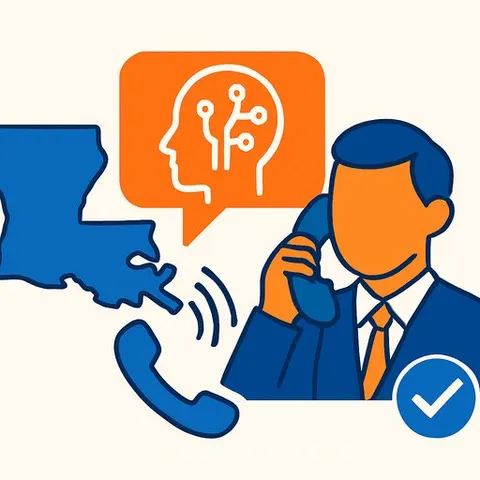
Louisiana's Act 559, which took effect August 1, imposes new disclosure rules on campaign communications made with artificial intelligence. The law targets a specific vulnerability for PR and communications professionals: the growing inability of voters to distinguish real messages from AI-generated fakes. Any phone call or automated call that uses AI to replicate the voice of a public figure must now include a clear disclosure at the start of the call.
The measure arrives as midterm elections approach and AI voice cloning reaches a level where it can "mimic the human voice perfectly," said Robert Collins, a Dillard University political analyst. The law's co-author, Rep. Michael Bayham, framed it as a direct response to that technical reality. "The new law is intended to prevent people from using AI to create fake voices, essentially impersonate people, provide fake messaging. We want to stop that so people aren't getting tricked through these new advances in technology," Bayham said.
What the law requires
The statute is specific about timing. The disclosure must come at the beginning of the call. Bayham noted that burying a disclaimer after a pause or at the end of a message won't satisfy the requirement. "They can't wait until after the call's done and there's a gap of silence. People think the call's over and hang up. This is to give people a heads up," he said.
The Louisiana Ethics Board will enforce the rules. A first violation carries a civil fine of up to $2,500. Second and subsequent violations can reach $5,000. The law applies to any telephone call or automated call created using AI that features the voice of an elected official or limited public figure.
The risk to information integrity
Collins pointed to a structural problem that communications professionals must now navigate. "The whole problem with artificial intelligence is that it allows people to mimic the human image and the human voice to an extent that the average voter cannot tell the difference," he said. This gap between technological capability and public detection creates an environment where deceptive content can spread before anyone questions its authenticity.
Collins advised that voters and audiences apply a simple verification test. "Even if there's no disclaimer, they have to ask themselves, is this something that this candidate would really say based on what I know about this candidate and based on what I've seen them say or based on their campaign literature?" he said. The broader stakes extend beyond any single campaign. "It could definitely corrupt the body politic. It could definitely corrupt democracy because democracy is dependent on people getting factual information and then acting on factual information," Collins said.
Why this matters for PR and communications
Louisiana's law signals a regulatory direction that communications teams should track closely. As AI-generated content becomes indistinguishable from authentic recordings, the burden shifts to disclosure and audience education. For PR professionals managing political accounts or public figures, compliance means building pre-call disclosures into every AI-assisted phone script now - not after a fine arrives. The law also creates a new reputational risk: a candidate or organization caught using undisclosed AI voice cloning faces both financial penalty and a trust deficit that no press release can fix. Professionals working in AI for PR & Communications will need to audit their campaign workflows and train teams on disclosure requirements before voice cloning tools enter the production pipeline. For those specializing in earned media and journalist relationships, the same detection challenges apply to audio pitches and broadcast segments - making the skills covered in AI for Media Relations Specialists directly relevant to protecting credibility in an election cycle where synthetic media is already in circulation.