
AI news ·
New Mexico schools clash with state over AI reading tool that records young students' voices
New Mexico's mandatory Amira reading test records young students' voices, sparking a privacy push from 35 lawmakers who want parental consent before the tool is used.
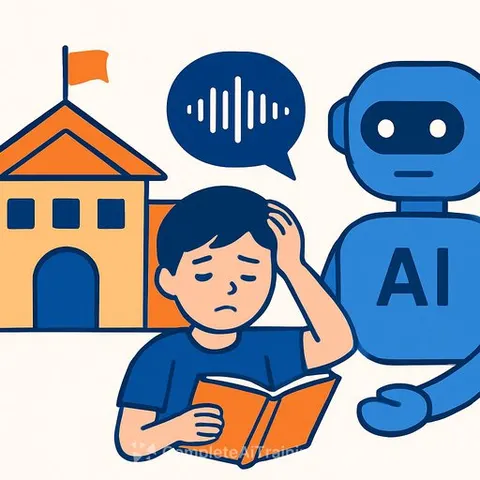
A mandatory AI reading assessment for New Mexico's youngest students has sparked a privacy debate between parents, school districts, and the Public Education Department (PED), with the software company at the center now defending its recording practices.
The PED requires school districts to use Amira Learning for students in kindergarten through second grade. Districts can opt out, but only if they use a paper version of Amira, an approved alternative, or the same program with audio storage disabled.
How the recordings work and why they're kept
Amira assesses reading ability by listening to children read aloud. That process records student voices. "The fact that they are recording children is a little bit concerning," said Shannon Dailey, an Albuquerque Public Schools parent.
Mark Angel, CEO of Amira Learning, said recordings are essential. "We have to process that oral reading. That's how Amira does her job, just in the same way that a human, a person, would listen to a student and use that listening to understand when the student is reading successfully and when they're having challenges," Angel said. The recordings are also stored so teachers can review them later.
Amira's privacy statement says the company does not sell data or voice recordings to other AI companies. In response to privacy concerns, PED reached an agreement with Amira to delete recordings monthly unless a district requests otherwise. Last year's recordings were also deleted.
Districts take different approaches
Santa Fe Public Schools and Los Alamos Public Schools opted out of the program entirely. Albuquerque Public Schools arranged for student records to be deleted after 48 hours and allows parents to switch to a paper-and-pencil version by contacting the school principal. Rio Rancho Public Schools deletes audio after seven days, shorter than the 30-day state agreement allows. Las Cruces Public Schools is using Amira with audio recording disabled.
Rep. Linda Serrato, D-N.M., and 34 other lawmakers sent a letter to PED urging parental consent before using Amira. "Parental consent is really important, especially with young children. [So] you know what they're being exposed to, but also where their sensitive data is being deployed," Serrato said.
Concerns about model changes and student perception
Serrato also questioned whether the AI model is constantly changing and how mistakes are handled. Angel pushed back on the model-drift concern. "We lock down the way the assessment works each and every year, and so when a student takes a test in August or September, they're experiencing the same foundational model, the same basic interaction with the mirror that they do in May or June," he said.
Another worry Serrato raised is that young children may not distinguish between AI and a person. "We need…kids to understand that AI is not a person. It's not [sentient]. You know, it doesn't care about you or I. It doesn't know anything," she said. Sen. Jay Block, R-N.M., who originally signed the lawmakers' letter, later told PED he no longer has concerns about the software.
PED did not directly address the consent request but said it is open to conversations with lawmakers and committed to transparency. For parents like Dailey, the core issue remains unchanged. "Parents need to be made aware of this and give their permission, just like when we have to register, and they ask permission for pictures and whatnot to be used," she said.
Why this matters for educators
Educators implementing state-mandated tools like Amira face a dual pressure: complying with assessment requirements while addressing legitimate parent concerns about student data. Understanding the specific data retention policies your district has negotiated - and being able to explain those clearly to families - is now a practical necessity. For teachers looking to build broader literacy on AI tools in the classroom, AI for Teachers Courses offer structured guidance on responsible implementation. The variation across New Mexico districts also shows that local policy can shape how these tools operate, meaning your feedback to administrators can directly affect privacy safeguards.