
AI news ·
Nihilent founder says AI emotion sensing can reveal what consumers really feel
Nihilent's AI app nSEPIA reads emotions from facial expressions instead of surveys, claiming 85% accuracy after testing on 30,000 people. The Pune firm says consumers lie in questionnaires, but their faces reveal true reactions for marketers.
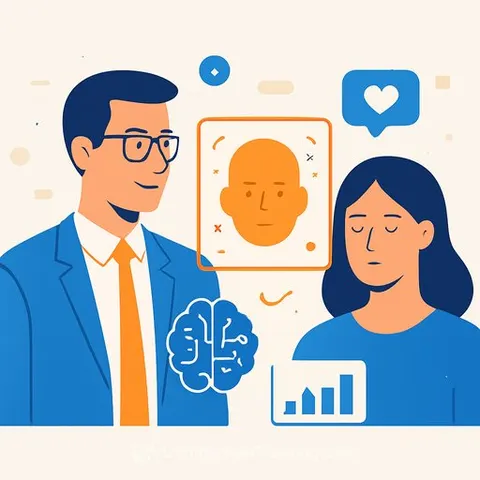
Nihilent has built an AI application called nSEPIA that reads emotional states by observing people rather than asking them questions. The Pune-based company says it has tested the system on 30,000 people and launched 2,000 on beta, with an 85 percent accuracy rate on scores of 4.5 and above. For marketers, the pitch is simple: consumers lie in surveys, but their faces don't.
L.C. Singh, founder and executive chairman of Nihilent, said the technology captures more honest responses than traditional market research. "Even in market research, you pay an audience to answer questions. But people do not always respond correctly because they tend to give socially acceptable answers," he said. "Here, there is no question. You consume something and the app can determine whether you are happy or unhappy."
Singh described a test with an international company launching a product. Consumers gave polite answers in surveys, but their emotional responses while actually using the product were far more accurate. "They may say, 'Yes, it is fine,' because they have been paid to participate. But they may not actually like it," he said.
What emotion sensing adds to consumer data
Emotion sensing can pick up feelings people don't express, including underlying stress that has nothing to do with the product being tested. Singh gave the example of someone worried about a sick family member who appears fine in a meeting. "That underlying worry remains in your subconscious. Emotion sensing can potentially identify that underlying emotion."
Singh acknowledged the risk of misinterpretation, especially across cultures. He stressed that nSEPIA is not a clinical tool and should not be judged on a single reading. "We provide weekly and monthly reports to show how you are performing consistently. If someone is consistently showing signs of depression, for example, they should consult a doctor."
For marketers, the technology adds an emotional layer to consumer data that surveys can't reach. Singh said brands will "know exactly what consumers feel and whether something will click with them. There is no made up answer or artificial response."
Where the line sits between empathy and exploitation
Singh argued that emotion sensing actually punishes overpromising rather than enabling manipulation. "Marketers can lie to you while selling a product. But once you have bought and used it, you will know whether it actually works for you," he said. "If a company makes a promise and the product does not deliver, you will feel betrayed. That emotion can be measured."
He also described how buyers weigh value against cost beyond price. "It includes how far you have to travel, how stressful the process is, how the servicing is and other factors," he said. "If the cost becomes greater than the value, because of poor servicing or rude behaviour, for example, you reject the product."
His advice to marketers: "Do not overpromise. Make a moderate promise and overdeliver. That is how you develop loyalty."
Combining AI with Indian knowledge systems
Singh sees a commercial opportunity beyond marketing. He wants to use AI to package Indian traditions like Navarasa, yoga and meditation for global markets. "Why should we only borrow AI from outside? We can use AI to give our ancient wisdom a new form and export it to the world," he said.
"The people who developed Navarasa were scientists in their own way. They researched, thought deeply and spoke to people before developing these ideas." Singh said his motivation is simple: "Why can't we create something here, package Indian knowledge and sell it to the world?"
For marketers, the practical takeaway is that emotion sensing could replace paid survey panels with direct observation, reducing the gap between what consumers say and what they actually feel. That shift has implications for product testing, ad creative and brand loyalty measurement. Professionals who want to understand how AI is reshaping marketing can explore AI for Marketing training resources, and those focused on consumer insight work can find relevant guidance in AI for Market Research Analysts.
Why this matters for marketers
Emotion sensing changes the economics of consumer research. Instead of recruiting panels and designing questionnaires, brands could test products with smaller groups and read reactions directly. The accuracy claims from Nihilent's beta - 85 percent on high scores - suggest the technology is past the lab stage. But the cultural caveats matter: a single reading is not a verdict, and brands that use emotion data to exploit vulnerability will face measurable backlash from the very tool they deployed.