
AI news ·
Nunavut AI correspondent draws outrage as media groups call copyright infringement blatant theft
A website with 121 AI-generated "journalists" is republishing copyrighted stories from Canadian news outlets without permission. News Media Canada calls it "industrial-scale theft" with no easy legal remedy, as copyright was left out of Canada's new $2-billion AI strategy.
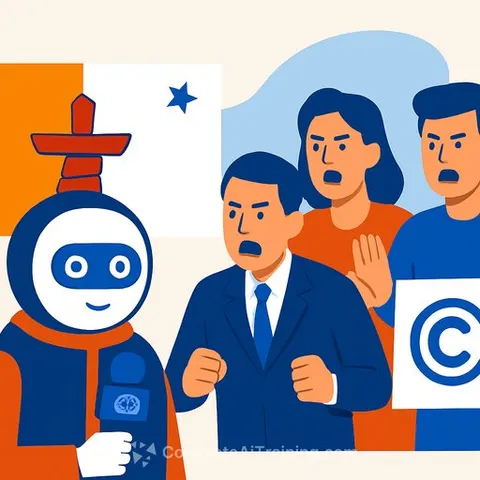
We-News.com, a website operating with 121 AI-generated "journalists," is systematically republishing copyrighted stories from Canadian news outlets including CBC North, Nunavut News, and Nunatsiaq News. The practice has drawn sharp criticism from media leaders who describe it as industrial-scale theft with no easy legal remedy, while raising fresh concerns about how AI-generated content misleads readers and undermines working journalists.
"The theft is blatant and it's happening on an industrial scale," said Paul Deegan, president of News Media Canada, which represents print and digital news publishers across the country.
One of the site's AI personas, Leah Qammaniq, is presented as an Inuk journalist raised in the North who covers Inuit self-governance and food security. Her publisher describes her writing as "warm, precise, and deeply local." The description rings true because the underlying reporting is real - it was produced by human journalists at northern newsrooms and then repackaged without permission.
How the operation works
We-News.com presents itself as a legitimate news outlet, claiming every story "is confirmed by multiple sources before publication." But when Nunatsiaq News attempted to contact the site using its published email address, the message bounced back. The website is owned by Hong Kong-based AZ Medias Ltd., its publisher is listed as David Dragesco, and its hosting provider is in France. Attempts to reach Dragesco, a search-engine optimization expert whose business site is also published by AZ Medias Ltd., received no response.
Unlike a real newsroom, fake outlets cannot be held accountable the same way when they publish false information. Brent Jolly, president of the Canadian Association of Journalists, said the public remains largely unaware of the problem. "It frustrates me to no end that this is something that the public doesn't seem to realize, and that we're not asking more questions about what's happening and how we can address this."
The copyright fight and government silence
News Media Canada has asked that the country's Copyright Act not be amended to create exceptions for text and data mining - a change Google has lobbied for in Generative AI and LLM training. Both Jolly and Deegan said they were disappointed that copyright was omitted from Canada's new AI strategy, which the Liberal government released earlier this summer with more than $2 billion in funding.
Nunatsiaq News asked Evan Solomon, Canada's minister of artificial intelligence, for his position on AI republishing of copyrighted newsroom material. He did not answer. Culture Minister Marc Miller, who co-hosted the country's first national summit on artificial intelligence, also did not state a position. A spokesperson for Miller wrote that the government "remains focused on helping journalists, writers and artists create and share the work that informs Canadians and tells our stories," noting an advisory council has been established to examine AI's impact on the cultural sector.
A flood of misleading content
Ahmed Al-Rawi, an associate professor at Simon Fraser University and lead on the Disinformation Project, said sites like We-News create confusion even when they disclose their use of AI. "The problem is that they actually have a picture of the alleged author of each news article, and that picture is a human, so it's confusing," he said. "One has to read the fine lines in order to figure it out."
These websites may be driven by ad revenue, Al-Rawi said, or they could represent foreign actors attempting to manipulate public opinion. The sheer volume of AI-generated material makes detection and enforcement increasingly difficult. "It's really hard to identify the sources of these websites," he said.
Right now, the only recourse for newsrooms is litigation - an option Deegan called unrealistic. Many publishers cannot afford to sue, and tracking down offenders across international borders to serve legal documents is daunting. Even when one site is shut down, others appear. "It's a game of whack-a-mole," Jolly said.
Why this matters for writers
When AI systems repackage your reporting without credit or compensation, they strip away both the economic value of your work and the trust readers place in bylines. The We-News case shows that disclosure labels and fake author photos can make AI-generated content feel authentic, which directly competes with real writers for audience attention and ad dollars. For writers building careers on expertise and local knowledge, the threat is not abstract - it is already live, and current copyright law offers little protection. Understanding how these systems operate, and where the legal gaps exist, is essential for anyone earning a living through original reporting or AI for Writers content creation.