
AI news ·
On-premises voice AI lets healthcare organizations capture clinical conversations without violating HIPAA
Only 21% of physicians use AI for notetaking. Most healthcare teams can't adopt standard AI meeting tools because HIPAA rules prohibit sending patient data to external cloud servers.
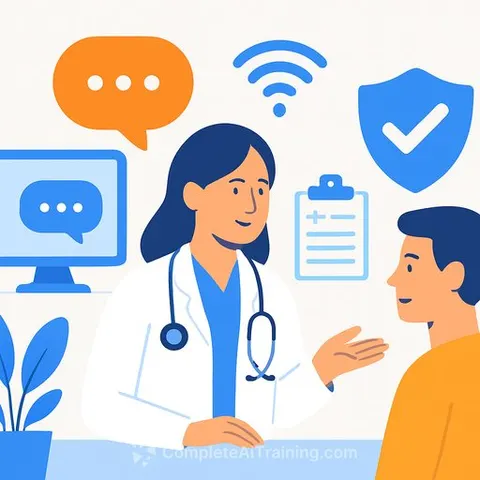
Healthcare Can't Use Most AI Meeting Tools. Here's Why.
Sixty percent of desk workers now use AI regularly, according to Slack's 2025 Workforce Index. Healthcare lags far behind. Only 21% of physicians use AI for notetaking-most teams still capture meeting notes manually.
The reason is straightforward: regulations like HIPAA require that protected health information (PHI) stay within secure, controlled environments. Most AI meeting tools process data in external cloud services, which means healthcare organizations cannot use them without risking compliance violations.
The cost of manual notes in healthcare
Some of the most consequential decisions in hospitals happen in staff meetings, care coordination sessions, case reviews, and shift handoffs. These conversations shape patient outcomes.
But without reliable capture, teams rely on memory and fragmented notes. A decision or insight from Monday may only be partially remembered by Friday. Over time, this creates misalignment and missed opportunities to improve patient care.
Why cloud-based AI doesn't work
Standard AI meeting tools are built for cloud-first environments. They send audio to remote servers for processing, then return transcripts and summaries. That model fails in healthcare.
Healthcare data lives across electronic health records, on-premises servers, and legacy telephony systems that predate modern cloud collaboration. Many clinical networks are segmented to prevent PHI from leaving the perimeter. Some facilities operate with little to no external internet connectivity. A voice AI system that depends on cloud processing cannot function in these environments.
On-premises voice AI works differently
On-premises systems deploy generative AI models locally. Nothing is sent to external servers. Data never leaves the building.
By transcribing, summarizing, and storing data within the organization's own infrastructure, the technology integrates with existing clinical environments-including legacy telephony and offline meeting rooms. Conversations can be captured across phone calls, in-room recordings, and scheduled video meetings.
Four concrete benefits for healthcare teams
- HIPAA-aligned AI adoption. Audio and transcripts are processed and stored entirely on-site. PHI never touches external infrastructure. Healthcare organizations gain access to AI meeting intelligence without compliance risk.
- Care continuity across clinical workflows. Automatic transcription and summarization creates a reliable record that persists across shift changes. Vital context and patient nuances are accurately carried forward during handoffs, reducing information gaps.
- Reduced administrative burden on clinicians. Clinicians spend significant time on documentation unrelated to direct patient care. On-premises voice AI auto-generates summaries in required formats like SOAP notes or shift reports. By automating documentation, these systems reclaim clinical time.
- Traceability for risk management and audits. When summaries are tied directly to original audio, it creates a defensible audit trail that is inherently compliance-aligned. If a review requires verification, the full transcript and audio source are readily available. Organizations become audit-ready from the moment a conversation ends.
Healthcare organizations have waited for AI for Healthcare tools that work within their environment. Speech-To-Text technology deployed on-premises delivers that. The organizations that move first will be better coordinated, more accountable, and better positioned to extract valuable insights from the conversations that drive their most important decisions.