
AI news ·
OpenAI adds ChatGPT for teens as educators debate AI in classrooms
OpenAI launched ChatGPT for Teens for students aged 13 to 17, adding a "Study Mode" that guides rather than answers, as over 50% of U.S. teens now use AI for schoolwork. Educators are split on whether the tool aids learning or risks critical thinking.
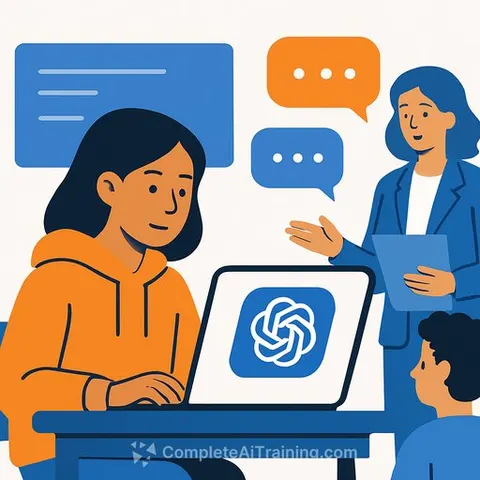
OpenAI has introduced ChatGPT for Teens, a version of its chatbot designed specifically for students aged 13 to 17. The company says the tool is meant to help teens learn, think critically, and use AI with confidence, and it arrives as more than half of U.S. teens report using AI for schoolwork, according to a February Pew Research Center survey.
The rollout adds to a growing education market that already includes Google's Gemini and Anthropic's Claude, both of which have released features aimed at schools. ChatGPT for Teens includes a "Study Mode" that provides guiding questions and step-by-step support instead of direct answers when students review homework.
Educators are split on whether this is progress or a problem.
Teachers who use AI in the classroom
Mark Casto, a chemistry teacher and science department head at Amesbury High School in Massachusetts, has used AI in his classes since attending a Northeastern University workshop for high school teachers last year. His students use Google's Gemini to generate research topics for a capstone project, a task he said was always difficult to teach.
"One of the biggest obstacles I always had was how do you generate really good topics to research that are practical or could be done within a school setting," he said.
When he heard about ChatGPT for Teens, he said he was excited about its classroom applications. "This is exactly what we're trying to do as teachers anyway - trying to teach students how to use it to make quizzes and as a study tool," he said.
Jennifer Love, a teaching professor in the College of Engineering and associate director of the Michael B. Silevitch and Claire J. Duggan Center for STEM Education at Northeastern, helps lead the workshop Casto attended. She said the program focuses on helping teachers use AI as a supplement to their own expertise, not a replacement for it.
"They are the ones with the subject matter expertise," she said, adding that AI should help teachers differentiate lessons, such as adapting a high school plan for younger students, or handle administrative tasks like updating rubrics. That frees up time for teachers to build relationships with students, she said.
For educators looking to build these skills, resources like the AI Learning Path for Teachers offer structured training on integrating tools like ChatGPT into lesson planning and student support.
Skeptics see risks to critical thinking
Sarah Rothschild, an educator in Maryland who works with both college and high school students, said she has watched students use AI to cheat on essays, write discussion posts, and respond to classmates' posts.
"I am watching AI slop respond to AI slop in an online classroom," she said, referring to low-quality AI-generated content.
Rothschild said she has responded by adding more in-class exercises and requiring students to show multiple drafts of their work. She has "deep skepticism" about ChatGPT for Teens and believes AI has limited utility, particularly in the humanities.
Annika Marie Schone, a Northeastern professor in the Bouve College of Health Sciences and a researcher in AI health safety, said the concerns are warranted. While OpenAI claims the tool will improve critical thinking, that claim cannot be independently verified, she said.
"We really don't know what the outcomes will be from all their interventions," she said. "There is a lack of regulations. … There are no reporting requirements for [these AI companies]."
Northeastern Global News reached out to OpenAI for comment but had not heard back at publication time.
Why this matters for educators
The debate over ChatGPT for Teens is not theoretical. A February Pew Research Center report found that more than 50 percent of teens use AI for schoolwork, and a survey from Instructure, the company behind Canvas, found that 90 percent of higher education students use AI at least occasionally to complete assignments.
Teachers who ignore that reality may find students using AI anyway, without guidance. Casto said it's better to bring the tools into the classroom on purpose.
"You have to allow them to use it because if you are not allowing them to use it in the classroom, then they're going to use it at home," he said. "There's an understanding that is a powerful tool. If you train them [well] to use [it] then you're only helping to enrich their experience."
For educators, the practical takeaway is clear: establish classroom policies for AI use now, decide which assignments benefit from AI support and which don't, and test the tools yourself before introducing them to students. The broader AI for Education conversation is moving fast, and teachers who engage with it directly will be better positioned to set the terms rather than react to them.