
AI news ·
Orion's $2,195 AI mattress pad improves sleep but struggles to justify its price
Orion's $2,195 mattress pad uses AI to cool your bed and learn your sleep patterns, now discounted to $1,795 for Black Friday.
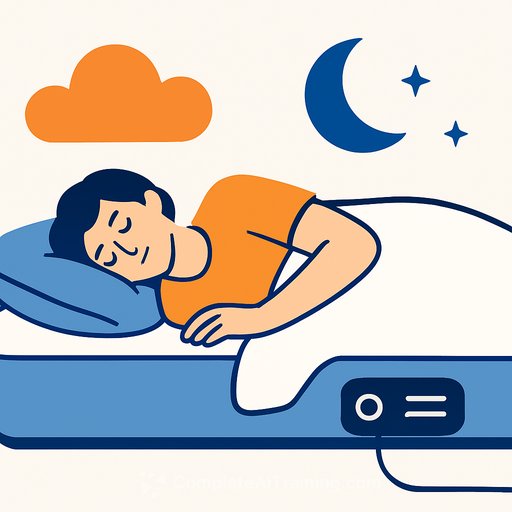
Orion is selling a $2,195 mattress pad that uses AI to adjust its temperature while you sleep, now discounted to $1,795 for Black Friday. The system promises to reduce nighttime wake-ups by actively cooling the bed and learning from your sleep patterns - a pitch that targets the same longevity-focused professionals who have made sleep optimization a priority in health-conscious industries.
How the cooling system works
The Orion Sleep System is a plush mattress pad connected by tubes to a control tower that doubles as a bedside table. Users pour water into the tower, which circulates through the pad to cool the surface. The default program begins cooling around a manually set bedtime, drops the temperature further as you fall asleep, then gradually warms the pad back to room temperature when it's time to wake up.
For couples, the pad can split into two zones with independent cooling schedules. After months of use, the water reservoir hasn't needed a refill. Setup took minimal effort despite the product arriving in two large boxes. Once configured through the Orion phone app, the system runs with very little ongoing maintenance.
The AI claims and the skepticism
Orion says its AI learns from sleep data to modulate temperatures and maximize sleep quality. The app tracks metrics like time spent in light sleep, deep sleep, REM, and how often you toss and turn. In practice, the cooling effect feels like finding the cold side of the pillow - except the entire mattress surface stays cool.
Whether the AI features justify the price remains an open question. The core value - a bed that stays cool on a schedule - doesn't strictly require machine learning. The sleep data is transmitted over the cloud for processing, which introduces the standard privacy risks of any connected health device. Founder Harry Gestetner said Orion invests heavily in security, but acknowledged the inherent risk of third-party data exposure.
From creator monetization to sleep tech
Gestetner, 26, sold his previous company Fanfix, a creator monetization platform, for an estimated $65 million when he was 21. The health problems that emerged during that grind - an inner ear condition that incapacitated him - pushed him toward the longevity movement. "I was in the office seven days a week, totally neglecting every other area of my life, neglecting my health, sleeping terribly, eating terribly, not working out, and I started to get health problems," Gestetner said.
He now believes we are five years from "longevity escape velocity," the point where AI-driven science adds an additional year to your life for every year you're alive. But he frames Orion in simpler terms. "I think most people just want to feel good, and you know, be able to go play soccer with their grandkids up into their older years," he said. "I think sleep is the cornerstone of longevity."
The pricing problem and what comes next
At $2,195 - or $1,795 on sale - Orion sits below competitor Eight Sleep's $3,000 model but remains out of reach for most buyers. Gestetner said the company is working toward a $500 product. "To use the Tesla analogy, this product is our Roadster, and we want to eventually get to our Model 3," he said.
In testing, the pad delivered noticeably better sleep. But so did a $59 device that simply limits phone usage before bed - a reminder that sleep quality has multiple levers, and the most expensive one isn't always necessary.
Why this matters for creatives, marketers, and product developers
Orion's pricing strategy - launching with a premium product to fund development of a mass-market version - mirrors the playbook many product teams study. For marketers and sales professionals, the framing around "longevity" and sleep-as-performance taps into a growing consumer willingness to spend on health optimization. Hospitality and events professionals should note the dual-zone cooling feature, which addresses a genuine pain point for couples with different temperature preferences - a detail that could influence future guest experience design. Healthcare workers, who often work irregular shifts and struggle with sleep, may find the scheduled temperature modulation concept relevant even if the current price excludes them from the market.